

Sermons
Mothers, Who Needs 'Em - Genesis 24
 Mothers. They are the first people any of us ever come into contact with. To say that mothers are vital to our existence is as obvious as the noses on our faces. The care and nurture that has come from good mothering is incalculable in its value.But we don’t need a mother anymore. That is to say we don’t need a mother in the sense that Abraham and Isaac did. In Genesis 24 there is a crisis: without a wife for Isaac there is no mother to continue Abraham’s line. If there is no continuation of Abraham’s line, then there is no Jesus Christ (see the Gospel according to Matthew 1:1). If there is no Jesus Christ, then all that is wrong in the world will not be made right again. We needed a mother, and we needed one badly. Through an unequivocal governing of events, Rebekah was singled out by the LORD to be the next mother of Israel. For over a millennium, countless mothers in Israel continued to bear the seed of Abraham until the last mother conceived: Mary. Although both Rebekah and Mary were virgins, Mary contrasts with Rebekah in an important way. Mary remained a virgin and yet conceived – another unequivocal governing of events by the LORD to bring about his kind promises of renewal. The child in her womb would grow to the One: Jesus Christ the ultimate fulfillment of the covenant made with Abraham (see Galatians 3:10-14).[caption id="attachment_4065" align="alignleft" width="236"]
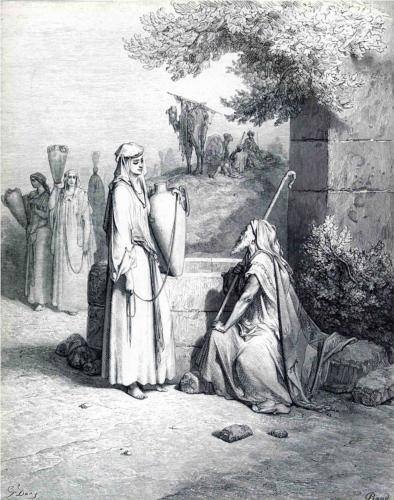 Eliezer and Rebekah by Gustave Dore[/caption]So, the fulfillment of God’s covenantal promises to Abraham required a mother. But they don’t anymore. We don’t need a mother because we do have a brother: Jesus Christ. Our brother Jesus Christ was sent by our Father to die and rise from the dead so we could be adopted into his family through the Comforter, the Spirit of Adoption (see Romans 8:15). So the first thing Genesis 24 teaches us is that we should grow in joy because we have a loving Brother, and a providing Father, and a Comforter through God’s provision of countless mothers.Yet the covenant promises of God continue to play out. We await the return of Jesus Christ by actively expanding the boundaries of the kingdom of God through all nations in every sphere of society. We are called to be witnesses to this great work of God in every relationship and role that we find ourselves in. So the covenant people of God need mothers now more than ever. The Church needs video game inventors, soccer coaches, grandfathers, woodworkers and engineers. Christ’s family needs sisters, politicians, jackhammer workers and poets. By the help of the Spirit of Christ, we need every person giving everything to this great and good work of God.Questions for Conversation
- Read Genesis 24
o Why would you assert that this story is not primarily about whether every woman should wear nose rings? Give evidence.o Why would you say that this scene is not primarily about how Christians are supposed to find wives? Give reasons.o Why would you claim that this passage is not primarily about how to obtain information about the will of God today? Substantiate the claim. (Hint: remember that revelation is historically progressive in the Bible).
- What relationships are you most passionate about in life? What roles do you find yourself that energize you?
- Tell your conversation partner(s) a story about that relates to that relationship or role. (for example: I am passionate about being a godly father and recently my son and I went to a great baseball game. Here’s what happened…).
- Now tell how you think God would have you like out that role in the future. (for example: my long distance friend and I swap dozens of books and discuss via Skype how they are truly helping us love God and emotionally connect with our wives. Meanwhile I also buy my wife a nose-ring in order to honor Rebekah's mothering of Israel.)
Genesis 23
Genesis 23 Sarah lived 127 years; these were the years of the life of Sarah. 2 And Sarah died at Kiriath-arba (that is, Hebron) in the land of Canaan, and Abraham went in to mourn for Sarah and to weep for her. 3 And Abraham rose up from before his dead and said to the Hittites, 4 "I am a sojourner and foreigner among you; give me property among you for a burying place, that I may bury my dead out of my sight." 5 The Hittites answered Abraham, 6 "Hear us, my lord; you are a prince of God among us. Bury your dead in the choicest of our tombs. None of us will withhold from you his tomb to hinder you from burying your dead." 7 Abraham rose and bowed to the Hittites, the people of the land. 8 And he said to them, "If you are willing that I should bury my dead out of my sight, hear me and entreat for me Ephron the son of Zohar, 9 that he may give me the cave of Machpelah, which he owns; it is at the end of his field. For the full price let him give it to me in your presence as property for a burying place." 10 Now Ephron was sitting among the Hittites, and Ephron the Hittite answered Abraham in the hearing of the Hittites, of all who went in at the gate of his city, 11 "No, my lord, hear me: I give you the field, and I give you the cave that is in it. In the sight of the sons of my people I give it to you. Bury your dead." 12 Then Abraham bowed down before the people of the land. 13 And he said to Ephron in the hearing of the people of the land, "But if you will, hear me: I give the price of the field. Accept it from me, that I may bury my dead there." 14 Ephron answered Abraham, 15 "My lord, listen to me: a piece of land worth four hundred shekels of silver, what is that between you and me? Bury your dead." 16 Abraham listened to Ephron, and Abraham weighed out for Ephron the silver that he had named in the hearing of the Hittites, four hundred shekels of silver, according to the weights current among the merchants. 17 So the field of Ephron in Machpelah, which was to the east of Mamre, the field with the cave that was in it and all the trees that were in the field, throughout its whole area, was made over 18 to Abraham as a possession in the presence of the Hittites, before all who went in at the gate of his city. 19 After this, Abraham buried Sarah his wife in the cave of the field of Machpelah east of Mamre (that is, Hebron) in the land of Canaan. 20 The field and the cave that is in it were made over to Abraham as property for a burying place by the Hittites.
This Is Only a Test - Genesis 22
Creatures are contingent. Creatures who have sinned against their holy Creator are most certainly contingent, only breathing by the mercy of their kind Creator who desires their repentance. In Genesis 22 Moses recounts the history of God’s testing of Abraham. The test consisted of God’s commanding Abraham to sacrifice his son Isaac. God’s command was therefore in direct conflict with his promise that through Isaac would come about a great nation that would bless all other nations. As Israel first listened to this account, they would have sensed the contingency of their own lives, as they imagined Isaac bound on the altar with a knife barreling down towards his throat. They would have been relieved when the angel of the LORD declared that Abraham need not touch Isaac and that through Isaac the covenant for creation’s renewal would continue. (The covenant with Abraham can be termed “the covenant for creation’s renewal,” as that is God’s purpose for entering into this covenant: to renew all of creation back to its original harmony). Yet, God’s command could still be kept, for the LORD provided a ram to be sacrificed in Isaac’s place. Not only so, but the ram was provided in the exact place (Moriah) that would later be the location of the temple where the LORD accepted the sacrifices of Israel for their sins. Even more significant is that just outside the walls of the same city is where the LORD provided a sacrifice on behalf of the life of his people: Jesus Christ, crucified outside the walls of Jerusalem.[caption id="attachment_4050" align="alignright" width="300"]
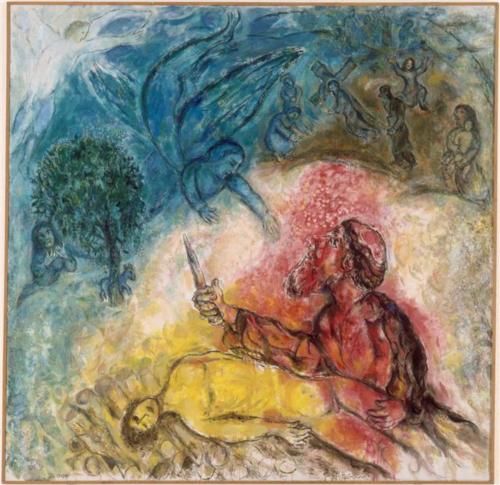 The Sacrifice of Isaac, by Marc Chagall, 1966[/caption]The covenant of creation’s renewal could only continue through Isaac, Israel and Jesus’ people today because of the LORD's provision. Jesus Christ, the Ram of God, sacrificed in the place of the people of God so that God’s good intentions for the nations can be accomplished by his grace and through his people. If the ram had not been provided, then the covenant promises could not have been accomplished and the world would have reverted back to Genesis 11. But I wonder if we really believe that. Do we really think that without the offspring of Abraham the world would revert back to the chaos of the Tower of Babel? Do we really feel the full impact of what was on the line as Isaac was on the altar? Do we sense the need for the Church, or do we think that the world will get along just fine by virtue of good governments, good schools and strong individual responsibility and hard work? Have we slipped into thinking that individual responsibility and ingenuity are the answer to the world’s problems? If so, we ought to be reminded that the LORD is the one who provides for the world’s true, deepest problems - and he does so through Jesus Christ: who gives life to his people for the sake of renewing creation by God’s power.Questions for Conversation
- Can you think of a movie, TV show or recent book in which the answer to the world’s problems came through individual responsibility and ingenuity?
- How would you counter that philosophy using the book of Genesis and God’s covenant with Abraham?
- This passage can be troubling. If you are troubled by it can you explain why? Does knowing that this is a test of Abraham help you? How?
- Where would you go in the Scripture to defend God’s honor regarding child sacrifice?
- How does this passage help you to better understand God the Father’s intention in Christ’s sacrifice?
Genesis 21:8-21
Genesis 21:8-21 8 The child grew and was weaned, and on the day Isaac was weaned Abraham held a great feast. 9 But Sarah saw that the son whom Hagar the Egyptian had borne to Abraham was mocking, 10 and she said to Abraham, “Get rid of that slave woman and her son, for that woman’s son will never share in the inheritance with my son Isaac.”11 The matter distressed Abraham greatly because it concerned his son. 12 But God said to him, “Do not be so distressed about the boy and your slave woman. Listen to whatever Sarah tells you, because it is through Isaac that your offspringwill be reckoned. 13 I will make the son of the slave into a nation also, because he is your offspring.”14 Early the next morning Abraham took some food and a skin of water and gave them to Hagar. He set them on her shoulders and then sent her off with the boy. She went on her way and wandered in the Desert of Beersheba.15 When the water in the skin was gone, she put the boy under one of the bushes. 16 Then she went off and sat down about a bowshot away, for she thought, “I cannot watch the boy die.” And as she sat there, shebegan to sob.17 God heard the boy crying, and the angel of God called to Hagar from heaven and said to her, “What is the matter, Hagar? Do not be afraid; God has heard the boy crying as he lies there. 18 Lift the boy up and take him by the hand, for I will make him into a great nation.”19 Then God opened her eyes and she saw a well of water. So she went and filled the skin with water and gave the boy a drink.20 God was with the boy as he grew up. He lived in the desert and became an archer. 21 While he was living in the Desert of Paran, his mother got a wife for him from Egypt.

Justice League of Heaven - Genesis 18:16-33
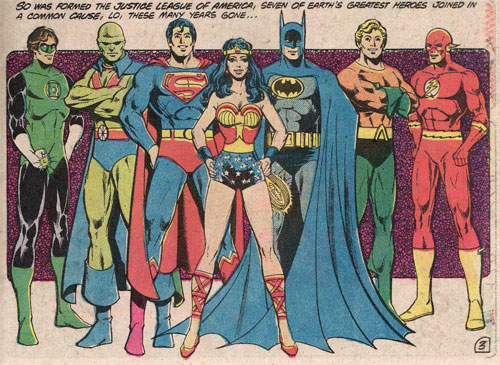 Did you ever read comic books or enjoy watching one of the recent Avengers movies? If so you are probably also familiar with The Justice League of America. The Justice League was made up of all the DC Comic Books greats: Wonder Woman, Batman, Green Lantern, Superman and others. Their whole mission was about bringing justice and righteousness into the world. With some modifications the same can be said of the Church of Jesus Christ, the seed of Abraham - we are the Justice League of Heaven.As those who know that they are secured a home in the new heavens and earth by grace through faith in Jesus we may wonder how living lives of justice and righteousness fits into the life of the Church. Maybe we are even tempted to think that justice and righteousness are for people caught up with being self-righteous. Certainly humans, in their rebellion against God, have shown the propensity for using their good works to turn their nose up at the world. But, when understood in the right way we see that justice and righteousness are simply the right response to God's mercy towards us. Living lives of justice and righteousness, God says, is what God called Abraham to do so that all the nations would be blessed. For you and I who have trusted in Jesus Christ, the Offspring of Abraham, we too have been ingrafted into the people of Abraham; through faith in Jesus Christ's death and resurrection on our behalf we have been given redemptive roles. As God says in Genesis 18:17-19, the nations will be blessed when Abraham and his household live up to their calling - to live lives of justice and righteousness.So, suit up Wonder Woman! Get your tights on Green Lantern! The Just and Righteous Lord of Heaven has forgiven you, adopted you and gifted you with his Holy Spirit so that you can help further the work of the greatest bunch of superheros ever - the Justice League of Heaven.Questions for Conversation- We learned about how God displays justice and righteousness through being non-prejudiced in his judgments of others, through hearing out the oppressed and correcting the oppressor, and by being more concerned to bless the world than to condemn. Which of these makes you admire God most? Why?- Who were your heros growing up? Why? Did they display aspects of justice and righteousness?- Where have you experienced injustice in life? Does that motivate you to want to address that injustice in life?- We learned that Abraham demonstrated the way of the Lord by interceding for Sodom and Gomorrah. Who do you have a hard time loving but need to begin praying for their good?

Communion Diet Plan - John 6
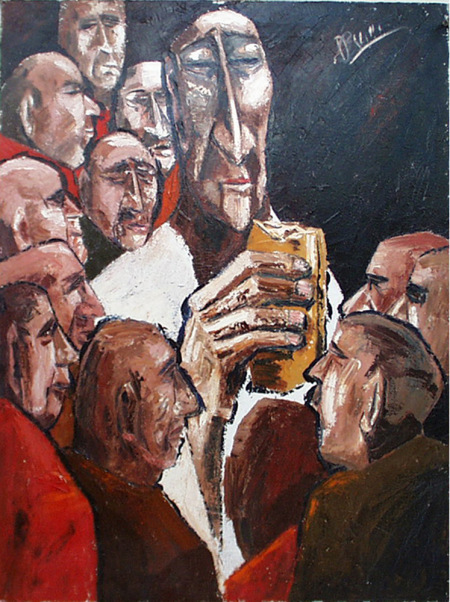 You’ve got to eat to live, and some diets promote life better than others. For example, the all-fried-chicken-and-cake diet isn’t going to leave you as fresh and healthy as the all-cabbage-and-low-fat diet (although you may be happier on the other). For as long as I can remember there has been a yearly frenzy about one new diet or another. Our hope at Crossroads is to be part of a movement to make a different diet all the frenzy: the Communion Diet.Jesus advocates this diet plan in John 6. Here is a short breakdown:
- The meal plan consists of Jesus’ flesh and blood.
- The food is absolutely free, provided at the expense of God the Father, Son and Holy Spirit.
- The food never goes bad – it is imperishable.
- The benefits are eternal life beginning now and a perfect body at the resurrection.
- It energizes you to live life for the right reasons.
- 100% satisfaction is guaranteed.
The reason it is called the “communion” diet plan is because of the relational nature of it. It is actually a feeding upon Jesus in the deepest of intimate relations. Or, to put it in other terms, by trusting in Jesus, we enter into a moment-by-moment daily transaction of receiving life from the Father through the Son and by the Holy Spirit. This is what it means to feed on Jesus.Of course, if you have been around church long enough, you are thinking of the Lord’s Supper or Communion. You should. Those who first read the sixth chapter of the Gospel of John would’ve been thinking of it also. During our faithful participation in the Lord’s Supper, we actually are fed the living and resurrected Christ by the mysterious power of the Holy Spirit. Although God’s people are always in union with Jesus Christ, there is a special way in which the Church communes with Jesus at the Table. Maybe it’s something like living in your family’s home all year but really deeply relating with everyone over Thanksgiving dinner.Not only do we deeply commune with the Triune God at the Lord’s Table, 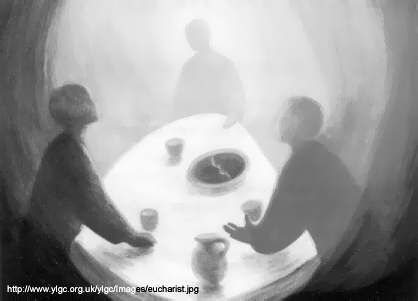 but we also keep the main thing the main thing. A church can easily become centered around lots of peripheral issues, but the Communion Diet keeps us focused on what’s important: the Trinity, the Incarnation, the atonement and forgiveness, the resurrection and eternal life, salvation by grace alone through faith alone in Christ alone to the glory of God alone.QUESTIONS FOR CONVERSATION
- Have you ever become bored with diets you’ve been on? Why?
- Can one become bored with God’s Diet Plan? How come?
- What kinds of emotions well up when you hear Jesus say that you must eat his flesh and blood (John 6:53)?
- Put in your own words what Jesus means by feeding upon his flesh and blood based on 6:56-57.
- Think of a neighbor, co-worker, or family member who is not on this Diet Plan. If you were to tell them about how to get on this Diet Plan, what would be the most important element to emphasize for them?
2 Corinthians 1:1-11
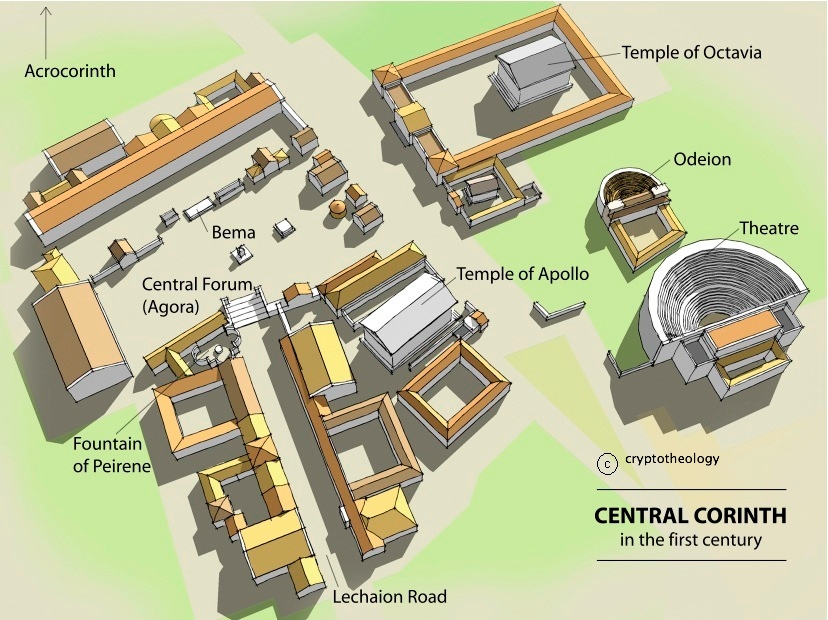 1 Paul, an apostle of Christ Jesus by the will of God, and Timothy our brother, To the church of God that is at Corinth, with all the saints who are in the whole of Achaia: 2 Grace to you and peace from God our Father and the Lord Jesus Christ.
3 Blessed be the God and Father of our Lord Jesus Christ, the Father of mercies and God of all comfort, 4 who comforts us in all our affliction, so that we may be able to comfort those who are in any affliction, with the comfort with which we ourselves are comforted by God. 5 For as we share abundantly in Christ's sufferings, so through Christ we share abundantly in comfort too. 6 If we are afflicted, it is for your comfort and salvation; and if we are comforted, it is for your comfort, which you experience when you patiently endure the same sufferings that we suffer. 7 Our hope for you is unshaken, for we know that as you share in our sufferings, you will also share in our comfort.
8 For we do not want you to be unaware, brothers, of the affliction we experienced in Asia. For we were so utterly burdened beyond our strength that we despaired of life itself. 9 Indeed, we felt that we had received the sentence of death. But that was to make us rely not on ourselves but on God who raises the dead. 10 He delivered us from such a deadly peril, and he will deliver us. On him we have set our hope that he will deliver us again. 11 You also must help us by prayer, so that many will give thanks on our behalf for the blessing granted us through the prayers of many.
You Can Trust These Guys - He's Risen! - John 20:24-28
[caption id="attachment_3947" align="alignleft" width="300"] Incredulity of Saint Thomas by Caravaggio, c. 1602[/caption] 24 Now Thomas, one of the Twelve, called the Twin, was not with them when Jesus came. 25 So the other disciples told him, “We have seen the Lord.” But he said to them, “Unless I see in his hands the mark of the nails, and place my finger into the mark of the nails, and place my hand into his side, I will never believe.” 26 Eight days later, his disciples were inside again, and Thomas was with them. Although the doors were locked, Jesus came and stood among them and said, “Peace be with you.” 27 Then he said to Thomas, “Put your finger here, and see my hands; and put out your hand, and place it in my side. Do not disbelieve, but believe.” 28 Thomas answered him, “My Lord and my God!” 29 Jesus said to him, “Have you believed because you have seen me? Blessed are those who have not seen and yet have believed.” 30 Now Jesus did many other signs in the presence of the disciples, which are not written in this book; 31 but these are written so that you may believe that Jesus is the Christ, the Son of God, and that by believing you may have life in his name.
Mediating Covenant - Genesis 17
[caption id="attachment_3893" align="alignleft" width="300"]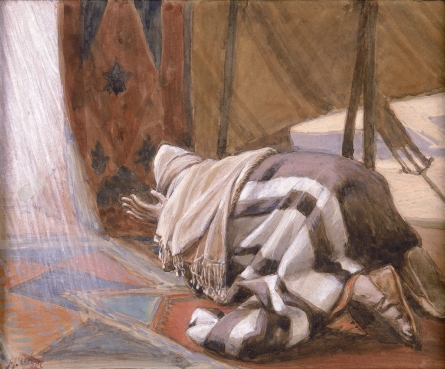 "God's Promises to Abraham" by James Tissot, c. 1896-1902[/caption]This past Sunday we learned of how God has assigned Jesus as the Mediator between God and man. As mediator Jesus takes what he knows of God’s covenant promises and makes them known to us (see Matthew 11:27). This role as covenant mediator was held for a time by Abraham (Genesis 17) (and others like Noah, Moses and David) but fully owned by Jesus.So what is this covenant that Abraham mediated between God and his people? You can call it the covenant for the renewal of creation. God promises to renew all of creation through the family of Abraham (Genesis 17:4-8). Abraham was given the sign of entrance into the covenant – the sign of circumcision (Genesis 17:9-14, 22-27). Circumcision pointed to the promise of an offspring who would come to stomp out the head of the serpentine evil that pervades the earth (Genesis 3:15).Later God instructed his people to make sacrifices through the covenant mediator Moses. Some of those sacrifices, like the peace offerings (Leviticus 3) and Passover (Exodus 12:1-28), were meant to be eaten by the people too.Jesus came to more fully and finally mediate the same ancient covenant for the renewal of creation (i.e., the Kingdom of God). He was the promised offspring, so the sign of circumcision was no longer needed. Instead, he mediated to us his Father’s wish that we now practice baptism as the entryway into the covenant family. And the night before he was sacrificed, he mediated a new sacrificial meal for us – communion.[caption id="attachment_3894" align="alignright" width="210"]
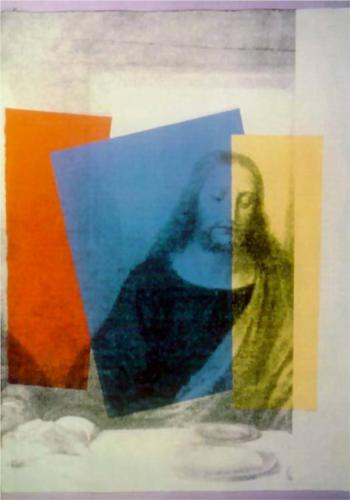 "The Last Supper" by Andy Warhol, 1986[/caption]Communion is a gift of God to us through the mediator Jesus. And it was mediated to us on this day – Maundy Thursday – some 2000 years ago. It was this very day some two thousand years ago that Jesus communicated to us his Father’s wish that we partake of this meal regularly. We are to do so in order that we remember and commune with the Father through the Son by the power of the Holy Spirit.“Maundy” comes from the Latin “mandatum novum” or “new commandment.” It has to do with Jesus’ new commandment that we “love one another” in John 13:34, which also took place at his last Passover meal. The love which he commands us to live is baked and aged into the bread and wine which we are to partake of in communion. It is his love, displayed in his crucifixion for us, that is then communicated to us at Communion. It is through receiving his love at his table that we are able to live lives of love like his.Questions for Conversation
- What is your earliest memory of Easter celebrations?
- Did your family go to Maundy Thursday service? Good Friday? Easter?
- What were those services like?
- When did you first enjoy Communion?
- How are the Father, the Son and the Holy Spirit involved in the celebration of Communion?
- What Scripture passages would you use to explain your answer?
Flesh or Spirit? - Genesis 16
[caption id="attachment_3973" align="alignleft" width="300"]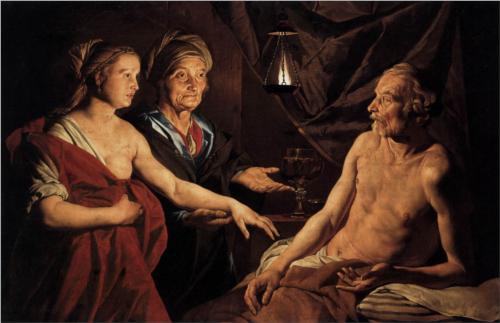 Sarah Leading Hagar to Abraham, Matthias Stom, 1637[/caption]Now Sarai, Abram's wife, had borne him no children. She had a female Egyptian servant whose name was Hagar. 2 And Sarai said to Abram, "Behold now, the LORD has prevented me from bearing children. Go in to my servant; it may be that I shall obtain children by her." And Abram listened to the voice of Sarai. 3 So, after Abram had lived ten years in the land of Canaan, Sarai, Abram's wife, took Hagar the Egyptian, her servant, and gave her to Abram her husband as a wife. 4 And he went in to Hagar, and she conceived. And when she saw that she had conceived, she looked with contempt on her mistress. 5 And Sarai said to Abram, "May the wrong done to me be on you! I gave my servant to your embrace, and when she saw that she had conceived, she looked on me with contempt. May the LORD judge between you and me!" 6 But Abram said to Sarai, "Behold, your servant is in your power; do to her as you please." Then Sarai dealt harshly with her, and she fled from her.7 The angel of the LORD found her by a spring of water in the wilderness, the spring on the way to Shur. 8 And he said, "Hagar, servant of Sarai, where have you come from and where are you going?" She said, "I am fleeing from my mistress Sarai." 9 The angel of the LORD said to her, "Return to your mistress and submit to her." 10 The angel of the LORD also said to her, "I will surely multiply your offspring so that they cannot be numbered for multitude." 11 And the angel of the LORD said to her, "Behold, you are pregnantand shall bear a son.You shall call his name Ishmael,because the LORD has listened to your affliction.12 He shall be a wild donkey of a man,his hand against everyoneand everyone's hand against him,and he shall dwell over against all his kinsmen." 13 So she called the name of the LORD who spoke to her, "You are a God of seeing," for she said, "Truly here I have seen him who looks after me." 14 Therefore the well was called Beer-lahai-roi; it lies between Kadesh and Bered.15 And Hagar bore Abram a son, and Abram called the name of his son, whom Hagar bore, Ishmael. 16 Abram was eighty-six years old when Hagar bore Ishmael to Abram.
Good Doubts and Good Complaints - Genesis 15
 After these things the word of the LORD came to Abram in a vision: "Fear not, Abram, I am your shield; your reward shall be very great." 2 But Abram said, "O Lord GOD, what will you give me, for I continue childless, and the heir of my house is Eliezer of Damascus?" 3 And Abram said, "Behold, you have given me no offspring, and a member of my household will be my heir." 4 And behold, the word of the LORD came to him: "This man shall not be your heir; your very own son shall be your heir." 5 And he brought him outside and said, "Look toward heaven, and number the stars, if you are able to number them." Then he said to him, "So shall your offspring be." 6 And he believed the LORD, and he counted it to him as righteousness.7 And he said to him, "I am the LORD who brought you out from Ur of the Chaldeans to give you this land to possess." 8 But he said, "O Lord GOD, how am I to know that I shall possess it?" 9 He said to him, "Bring me a heifer three years old, a female goat three years old, a ram three years old, a turtledove, and a young pigeon." 10 And he brought him all these, cut them in half, and laid each half over against the other. But he did not cut the birds in half. 11 And when birds of prey came down on the carcasses, Abram drove them away.12 As the sun was going down, a deep sleep fell on Abram. And behold, dreadful and great darkness fell upon him. 13 Then the LORD said to Abram, "Know for certain that your offspring will be sojourners in a land that is not theirs and will be servants there, and they will be afflicted for four hundred years. 14 But I will bring judgment on the nation that they serve, and afterward they shall come out with great possessions. 15 As for you, you shall go to your fathers in peace; you shall be buried in a good old age. 16 And they shall come back here in the fourth generation, for the iniquity of the Amorites is not yet complete."17 When the sun had gone down and it was dark, behold, a smoking fire pot and a flaming torch passed between these pieces. 18 On that day the LORD made a covenant with Abram, saying, "To your offspring I give this land, from the river of Egypt to the great river, the river Euphrates, 19 the land of the Kenites, the Kenizzites, the Kadmonites, 20 the Hittites, the Perizzites, the Rephaim, 21 the Amorites, the Canaanites, the Girgashites and the Jebusites."
Genesis Chapters 13-14
13 So Abram went up from Egypt to the Negev, with his wife and everything he had, and Lot went with him. 2 Abram had become very wealthy in livestock and in silver and gold.3 From the Negev he went from place to place until he came to Bethel, to the place between Bethel and Ai where his tent had been earlier 4 and where he had first built an altar. There Abram called on the name of the Lord.5 Now Lot, who was moving about with Abram, also had flocks and herds and tents. 6 But the land could not support them while they stayed together, for their possessions were so great that they were not able to stay together. 7 And quarrelling arose between Abram’s herdsmen and Lot’s. The Canaanites and Perizzites were also living in the land at that time.8 So Abram said to Lot, ‘Let’s not have any quarrelling between you and me, or between your herdsmen and mine, for we are close relatives. 9 Is not the whole land before you? Let’s part company. If you go to the left, I’ll go to the right; if you go to the right, I’ll go to the left.’10 Lot looked around and saw that the whole plain of the Jordan towards Zoar was well watered, like the garden of the Lord, like the land of Egypt. (This was before the Lord destroyed Sodom and Gomorrah.) 11 So Lot chose for himself the whole plain of the Jordan and set out towards the east. The two men parted company: 12 Abram lived in the land of Canaan, while Lot lived among the cities of the plain and pitched his tents near Sodom. 13 Now the people of Sodom were wicked and were sinning greatly against the Lord.14 The Lord said to Abram after Lot had parted from him, ‘Look around from where you are, to the north and south, to the east and west. 15 All the land that you see I will give to you and your offspring for ever. 16 I will make your offspring like the dust of the earth, so that if anyone could count the dust, then your offspring could be counted. 17 Go, walk through the length and breadth of the land, for I am giving it to you.’18 So Abram went to live near the great trees of Mamre at Hebron, where he pitched his tents. There he built an altar to the Lord.
Abram rescues Lot
14 At the time when Amraphel was king of Shinar, Arioch king of Ellasar, Kedorlaomer king of Elam and Tidal king of Goyim, 2 these kings went to war against Bera king of Sodom, Birsha king of Gomorrah, Shinab king of Admah, Shemeber king of Zeboyim, and the king of Bela (that is, Zoar). 3 All these latter kings joined forces in the Valley of Siddim (that is, the Dead Sea Valley). 4 For twelve years they had been subject to Kedorlaomer, but in the thirteenth year they rebelled.5 In the fourteenth year, Kedorlaomer and the kings allied with him went out and defeated the Rephaites in Ashteroth Karnaim, the Zuzites in Ham, the Emites in Shaveh Kiriathaim 6 and the Horites in the hill country of Seir, as far as El Paran near the desert. 7 Then they turned back and went to En Mishpat (that is, Kadesh), and they conquered the whole territory of the Amalekites, as well as the Amorites who were living in Hazezon Tamar.8 Then the king of Sodom, the king of Gomorrah, the king of Admah, the king of Zeboyim and the king of Bela (that is, Zoar) marched out and drew up their battle lines in the Valley of Siddim 9 against Kedorlaomer king of Elam, Tidal king of Goyim, Amraphel king of Shinar and Arioch king of Ellasar – four kings against five. 10 Now the Valley of Siddim was full of tar pits, and when the kings of Sodom and Gomorrah fled, some of the men fell into them and the rest fled to the hills. 11 The four kings seized all the goods of Sodom and Gomorrah and all their food; then they went away. 12 They also carried off Abram’s nephew Lot and his possessions, since he was living in Sodom.13 A man who had escaped came and reported this to Abram the Hebrew. Now Abram was living near the great trees of Mamre the Amorite, a brother of Eshkol and Aner, all of whom were allied with Abram. 14 When Abram heard that his relative had been taken captive, he called out the 318 trained men born in his household and went in pursuit as far as Dan. 15 During the night Abram divided his men to attack them and he routed them, pursuing them as far as Hobah, north of Damascus. 16 He recovered all the goods and brought back his relative Lot and his possessions, together with the women and the other people.17 After Abram returned from defeating Kedorlaomer and the kings allied with him, the king of Sodom came out to meet him in the Valley of Shaveh (that is, the King’s Valley).18 Then Melchizedek king of Salem brought out bread and wine. He was priest of God Most High, 19 and he blessed Abram, saying,
Then Abram gave him a tenth of everything.21 The king of Sodom said to Abram, ‘Give me the people and keep the goods for yourself.’22 But Abram said to the king of Sodom, ‘With raised hand I have sworn an oath to the Lord, God Most High, Creator of heaven and earth, 23 that I will accept nothing belonging to you, not even a thread or the strap of a sandal, so that you will never be able to say, “I made Abram rich.” 24 I will accept nothing but what my men have eaten and the share that belongs to the men who went with me – to Aner, Eshkol and Mamre. Let them have their share.’
It's Not Black and White - Genesis 12:10-20
[caption id="attachment_3976" align="alignleft" width="229"]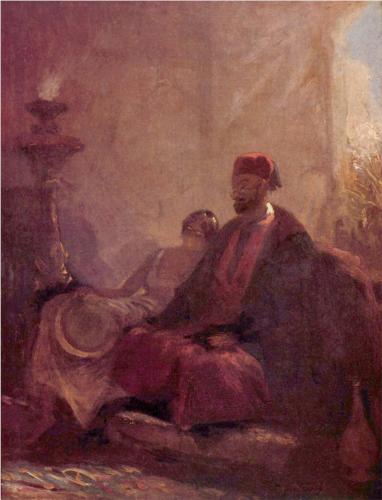 Harem by Carl Spitzweg[/caption]10 Now there was a famine in the land. So Abram went down to Egypt to sojourn there, for the famine was severe in the land. 11 When he was about to enter Egypt, he said to Sarai his wife, "I know that you are a woman beautiful in appearance, 12 and when the Egyptians see you, they will say, 'This is his wife.' Then they will kill me, but they will let you live. 13 Say you are my sister, that it may go well with me because of you, and that my life may be spared for your sake." 14 When Abram entered Egypt, the Egyptians saw that the woman was very beautiful. 15 And when the princes of Pharaoh saw her, they praised her to Pharaoh. And the woman was taken into Pharaoh's house. 16 And for her sake he dealt well with Abram; and he had sheep, oxen, male donkeys, male servants, female servants, female donkeys, and camels. 17 But the LORD afflicted Pharaoh and his house with great plagues because of Sarai, Abram's wife. 18 So Pharaoh called Abram and said, "What is this you have done to me? Why did you not tell me that she was your wife? 19 Why did you say, 'She is my sister,' so that I took her for my wife? Now then, here is your wife; take her, and go." 20 And Pharaoh gave men orders concerning him, and they sent him away with his wife and all that he had.
Go and Die and Live - Genesis 12:1-3
[caption id="" align="alignleft" width="189"] God Renews His Promises to Abraham by James Tissot, 1902[/caption]If someone were to say that religion is supposed to bring about an abundant life, I think we’d all agree. If another were to say that Jesus came to give life, there should certainly be rousing approval. Christ came to give life back to the world, for as John writes in his Gospel, “In him was life” (John 1:4).Yet, it doesn’t take long before we come across other statements in the Gospels where Jesus says he came to bring death. For example, "If anyone would come after me, let him deny himself and take up his cross daily and follow me.” The key is in seeing how death and life come together in his following statement: For whoever would save his life will lose it, but whoever loses his life for my sake will save it (Luke 9:23-24).So how do we understand our Lord? How can he both come to bring death but also come to bring life? And where is he coming up with this stuff anyway? For the answer, we ought to look back to Jesus’ Bible, or what we call the Old Testament.Take for example Genesis 12:1-3. Here we have Abram, part of the mass of a humanity clouded by the fallen dust of Babel’s tower and still wandering east of Eden. Abram is no better than the rest. Yet, God speaks to him words of life. He makes promises to Abram that he will give to him a great people in a place to call his own. God promises his presence to Abram along with a fascinating purpose. You could call these promises “The Four ‘P’s” – presence, place, people, and purpose – but Paul calls them the gospel (see Galatians 3:8).These four ‘P’s were the very bricks that the dreams of the Babelites were made of: having one place to live, as one people, with the blessing of God’s presence and a fulfilled purpose, resulting in a great name (see Genesis 11:1-9). Yet, the only way to these promises of life was through death. In order for Abram to obtain the promises, he had to trust God and leave all of the false ways of seeking these things. God called him to “Go” from his country, or land (place). God called him to “Go” from his kindred and his father’s house (his people and the presence of their gods). And all this put together meant giving up any claim to the fame of a great name (purpose). Who would remember Abram now as anything more than a traitor, an abdicator?So the only way to obtain the promises of life was to walk through death: death to the presence of false gods, death to the overestimation of people’s power, death to the pride of place, death to the human creation of purpose. Yet, through trusting the promise and leadership of this mysterious God, Abram would be led back into life the way it was always supposed to be, which fundamentally is friendship with God (see James 2:23).
 This is where Jesus got his crazy ideas – and he lived them out to the fullest. Through his death he makes our death possible. Through his resurrection he has made real life possible. Jesus went and died and lived. Through faith in him we follow him into death; through trusting him we follow him into resurrection (see Romans 6:1-11). Go and die and live - this is God's recipe for fixing a world gone wrong.Questions for Consideration
- What do you most hate about the idea of Jesus calling us to die? (if Jesus’ call doesn’t rub you the wrong way then you might want to check your pulse)
- Where is the Spirit of Christ seeking to lead you away from falsehood?
- People
- Place
- Presence
- Purpose
- What do you most love about Jesus calling us to resurrection?
- Where is the Spirit of Jesus seeking to empower you into resurrection?
- People
- Place
- Presence
- Purpose
Babel Babel - Genesis 11:1-9
 Do you like to laugh? You should definitely read the Bible. I don’t mean that in the sense that the contents are laughable or ridiculous. No, the contents ought to be regarded with the highest amount of respect, for they are the very Word of God. Rather, if you like to laugh, you should read the Bible because it is filled with accounts of irony, satire, incongruity, and hilarious plot reversals. Not to say that every page, chapter or book is filled with hilarity, but when we think of funny, we shouldn’t count God out.God has even chosen to make us laugh a little during very sobering moments or in the midst of very somber realities. Take the Tower of Babel in Genesis 11:1-9 for example. As one of the crowning moments of humanity’s folly, we sought to establish our identity (“let us make a great name for ourselves”) and our security (“lest we be dispersed over the face of the whole earth”) by means of our ingenuity and power, drawing God down out of the heavens to bless us (“let us build a city with a tower with its top in the heavens”). This was stupid and also very disrespectful. Let me explain. The city and tower made up an ancient religious complex. The city was where God was supposed to live, and the tower was a ziggurat. A ziggurat was like a pyramid, which at the top it had things like food and perfumes that would entice a needy God to come down and live among the people – bringing with her all the goodies from the heavenly dimension. The problem is that the only true God doesn’t need food or incense. He doesn’t need anything because he made everything, and he made everything because he wants everything to know what it is like to live in dependence upon such a divine, holy and personal Father.It begins to get funny when the tower that the people thought reached the heavens was so short God had to come down to see it. After a thorough investigation, which is one of God’s habits (compare with Genesis 3 and 4), he perceives that this willful ignorance of God’s true character will not lead society in the right direction. He frustrates their plans by confusing their speech, and they earn their name – Babel. That’s right: in setting out to make a great name for themselves apart from God’s wisdom and power, they earned the name of “Confusion.” To top off all of this irony and plot reversal, the name in Hebrew sounds like the babbling of some crazy man. This stuff is supposed to make you chuckle.[caption id="attachment_3807" align="alignright" width="300"]
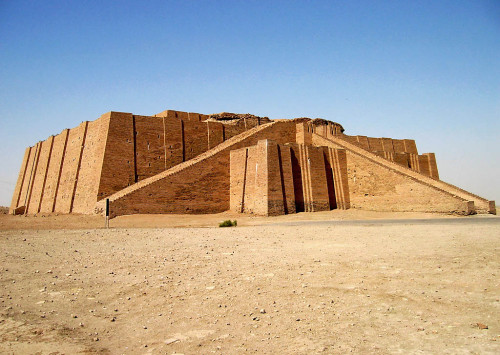 Ziggurat reconstructed in Ur, Iraq[/caption]So when the world is getting you down and you think everything will always go from bad to worse, remember that God will have the last word. When you are watching the nightly news and beginning to feel that anxiety crawl up your neck, turn off the TV and let out a long and enjoyable “BLBLBLBLBLBLB,” knowing that God will have the last laugh.
Genesis 8:18-9:17
18 So Noah came out, together with his sons and his wife and his sons’ wives. 19 All the animals and all the creatures that move along the ground and all the birds—everything that moves on land—came out of the ark, one kind after another.20 Then Noah built an altar to the Lord and, taking some of all the clean animals and clean birds, he sacrificed burnt offerings on it. 21 The Lord smelled the pleasing aroma and said in his heart: “Never again will I curse the ground because of humans, even though every inclination of the human heart is evil from childhood. And never again will I destroy all living creatures, as I have done.22 “As long as the earth endures,seedtime and harvest,cold and heat,summer and winter,day and nightwill never cease.”9 Then God blessed Noah and his sons, saying to them, “Be fruitful and increase in number and fill the earth. 2 The fear and dread of you will fall on all the beasts of the earth, and on all the birds in the sky, on every creature that moves along the ground, and on all the fish in the sea; they are given into your hands. 3 Everything that lives and moves about will be food for you. Just as I gave you the green plants, I now give you everything.4 “But you must not eat meat that has its lifeblood still in it. 5 And for your lifeblood I will surely demand an accounting. I will demand an accounting from every animal. And from each human being, too, I will demand an accounting for the life of another human being.6 “Whoever sheds human blood,by humans shall their blood be shed;for in the image of Godhas God made mankind.7 As for you, be fruitful and increase in number; multiply on the earth and increase upon it.”8 Then God said to Noah and to his sons with him: 9 “I now establish my covenant with you and with your descendants after you 10 and with every living creature that was with you—the birds, the livestock and all the wild animals, all those that came out of the ark with you—every living creature on earth. 11 I establish my covenant with you: Never again will all life be destroyed by the waters of a flood; never again will there be a flood to destroy the earth.”12 And God said, “This is the sign of the covenant I am making between me and you and every living creature with you, a covenant for all generations to come: 13 I have set my rainbow in the clouds, and it will be the sign of the covenant between me and the earth. 14 Whenever I bring clouds over the earth and the rainbow appears in the clouds, 15 I will remember my covenant between me and you and all living creatures of every kind. Never again will the waters become a flood to destroy all life. 16 Whenever the rainbow appears in the clouds, I will see it and remember the everlasting covenant between God and all living creatures of every kind on the earth.”17 So God said to Noah, “This is the sign of the covenant I have established between me and all life on the earth.”
God's Habits - Genesis 6
These are the generations of Noah. Noah was a righteous man, blameless in his generation. Noah walked with God. 10 And Noah had three sons, Shem, Ham, and Japheth. 11 Now the earth was corrupt in God's sight, and the earth was filled with violence. 12 And God saw the earth, and behold, it was corrupt, for all flesh had corrupted their way on the earth. 13 And God said to Noah, "I have determined to make an end of all flesh, for the earth is filled with violence through them. Behold, I will destroy them with the earth…17 For behold, I will bring a flood of waters upon the earth to destroy all flesh in which is the breath of life under heaven. Everything that is on the earth shall die. 18 But I will establish my covenant with you, and you shall come into the ark, you, your sons, your wife, and your sons' wives with you. 19 And of every living thing of all flesh, you shall bring two of every sort into the ark to keep them alive with you. They shall be male and female. 20 Of the birds according to their kinds, and of the animals according to their kinds, of every creeping thing of the ground, according to its kind, two of every sort shall come in to you to keep them alive. 21 Also take with you every sort of food that is eaten, and store it up. It shall serve as food for you and for them." 22 Noah did this; he did all that God commanded him….The flood continued forty days on the earth. The waters increased and bore up the ark, and it rose high above the earth. 18 The waters prevailed and increased greatly on the earth, and the ark floated on the face of the waters. 19 And the waters prevailed so mightily on the earth that all the high mountains under the whole heaven were covered. 20 The waters prevailed above the mountains, covering them fifteen cubits deep. 21 And all flesh died that moved on the earth, birds, livestock, beasts, all swarming creatures that swarm on the earth, and all mankind. 22 Everything on the dry land in whose nostrils was the breath of life died. 23 He blotted out every living thing that was on the face of the ground, man and animals and creeping things and birds of the heavens. They were blotted out from the earth. Only Noah was left, and those who were with him in the ark. 24 And the waters prevailed on the earth 150 days…. 13 In the six hundred and first year, in the first month, the first day of the month, the waters were dried from off the earth. And Noah removed the covering of the ark and looked, and behold, the face of the ground was dry. 14 In the second month, on the twenty-seventh day of the month, the earth had dried out. 15 Then God said to Noah, 16 "Go out from the ark, you and your wife, and your sons and your sons' wives with you. 17 Bring out with you every living thing that is with you of all flesh-- birds and animals and every creeping thing that creeps on the earth-- that they may swarm on the earth, and be fruitful and multiply on the earth." 18 So Noah went out, and his sons and his wife and his sons' wives with him. 19 Every beast, every creeping thing, and every bird, everything that moves on the earth, went out by families from the ark.