

Sermons
Dynamically Living with God - Genesis 35:1-15
 Jacob’s name change to Israel is re-affirmed in Genesis 35. “What is the background of your name? Why were you given your name? Were you, for instance, named after a relative, family friend, biblical character, athlete, movie star?” (taken from Dan Allender’s To Be Told)
- The Christian life is a dynamic one where we, as God’s people, are meant to interact with God in intimate covenant communion for the sake of the building of the Kingdom of his Son Jesus Christ. We saw this in the relationship between Jacob and God Almighty (El Shaddai) in Genesis 35. First God instructed Jacob how to relate to him, Jacob/Israel obeyed and then God met him again in a revealing of his promises to Israel for personal communion and kingdom building.
 How do we see the same dynamic relationship described by Jesus in John 14:21?

- The promises made to Jacob/Israel in Genesis 35 contain references to many other places in the Bible. These promises have been referred to as the 4 “P”s. Does anyone remember what they are?
- Have different members in the group turn to Genesis 1:26-28; 9:1; 12:1-3, 17:4-8 and 35:11-12 and show where they find the four “P”s of God’s covenant promises affirmed.
- What is one thing from last week’s sermon that you hoped we would talk about and why?
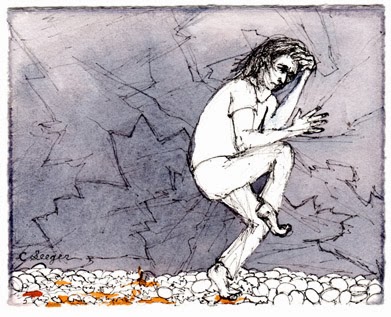
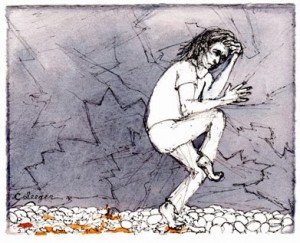 Pastor Tim pointed out that the Christian life is meant to be lived as a dynamic relationship where we are not “walking on eggshells” with God. What did he mean by “walking on eggshells”? Have you ever felt like you were “walking on eggshells” with God or somebody else? Explain.
The Grace of the Law - Genesis 34
[caption id="attachment_4215" align="alignleft" width="196"]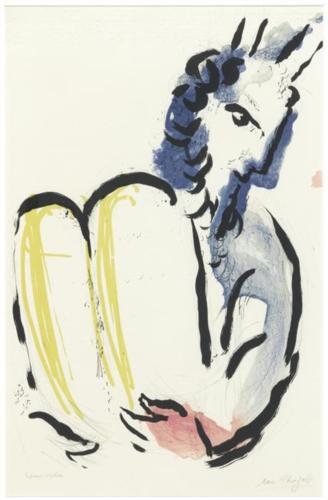 Moses, by Marc Chagall 1956[/caption]Following are questions for conversation based on the Genesis 34 sermon. Please feel free to leave questions or comment.
- Who is the author of Genesis? (Moses)
- Who is the original audience for whom the book of Genesis was originally written? (Israel after the Exodus and on the way to the promised land)
Read Genesis 34:
- Who is Dinah’s mother? Is she the more or less favored wife of Jacob?
- As appropriate to your group, discuss the following: What did Shechem do to Dinah?
- Has God revealed his laws to Israel at this point in history? When does God give the Ten Commandments and subsequent laws to Israel?
- How would God’s law have helped in a situation like this? (see Exodus 22:16-17 and Deuteronomy 22:28-29).
- Why might Jacob have under-reacted in hearing about the mistreatment of Dinah? (compare Jacob’s reaction in Genesis 34:5 to his reaction to Joseph’s supposed death in 37:31-35)
- When have you experienced or witnessed an under-reaction to evil? Share with the group.
- When the sons of Jacob return they react very strongly (v. 7) but then fail to exact a punishment that fit the crime (v. 25-29). How would laws from God have been a helpful provision in this case? Do any laws from the Old Testament come to mind as particularly relevant to this case? (see Exodus 21:23-24).
- When have you experienced or witnessed an over-reaction to evil? Share with the group.
- At the end of the story (v. 30-31) there is a disagreement between Jacob and his sons about what should have been done in response to Dinah’s severe mistreatment. Explain how this ending is “ambiguous.”
- How do God’s laws given to Israel clear up that ambiguity?
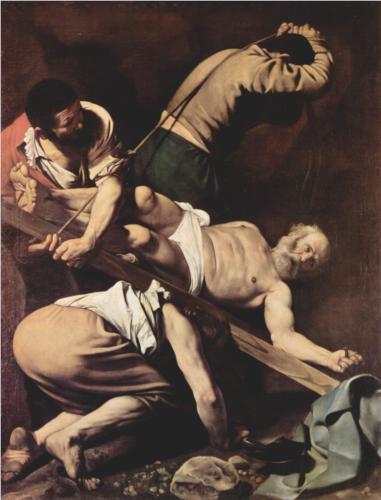
- The main point of this sermon was that the law is grace. How is law (or instruction) gracious?[caption id="attachment_4216" align="alignright" width="228"]
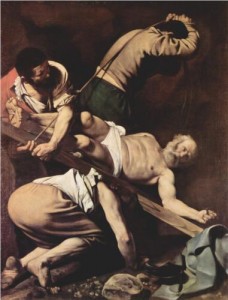 Crucifixion of Saint Peter, by Caravaggio 1601[/caption]
 - Jesus, in John 13:34, commands his disciples. What has he commanded us to do?
- How is Jesus' instruction to love like him (laying down your life for others as he has laid down his life for us) a gracious thing?
- No one perfectly loves like Jesus, and that is why we need to continually be reminded that we are rooted in his sacrificial, complete and perfect love for us (Ephesians 3:14-21). When have you seen a local church love like Jesus, laying down its life for the sake of others? What opportunities does Crossroads have to love others like Jesus?
God's Tricky but He's Good - Genesis 32:22-32
[caption id="attachment_4167" align="alignright" width="300"] Jesters by Viktor Vasnetsov, 1885[/caption]Questions for Conversation
- What has God already promised Jacob according to chapter 28:13-15?
- Who else did God make these promises to in prior chapters of Genesis?
- How do these promises line up with the way God set up human life at creation (see Genesis 1-2).
- Read chapter 32:1-21.
- Who is Jacob afraid will attack and kill him? Why would Jacob be afraid of this? (Hint: see Genesis 27)
- Read 32:22-24
- Who do you think Jacob assumed the man was who attacked him in the night (see v. 24)?
- Read 32:25-30
- Who does Jacob realize it is in v. 30?
- Some people wonder how God, who cannot be seen and is a Spirit, can physically wrestle Jacob. Hosea 12:2-4 explains that an angel wrestled with Jacob. This is common for an angelic emissary of God to be God’s representative
- This was tricky of God to lead Jacob (and the hearers of Genesis) to think that it was a man who wrestled with him. But through this tricky attack God accomplished a few things:
- God can and does act shrewdly (withholding information) – he can be tricky.
- God is committed to his ancestral covenant promises to Jacob and is willing to act tricky to make that known. Do you remember how the putting Jacob’s hip out of joint indicated God’s commitment to keep his promises? (hint: see Genesis 24:1-3).
- Jacob’s tricky ways can be employed for the sake of God’s mission too. Do you remember how God helped Jacob to act shrewdly with Esau? (hint: see Genesis 32:1 and the meaning of “Mahanaim” in the ESV margin note and compare with what Jacob does in 32:7
- How was Jesus’ crucifixion the greatest trick that God ever played?
- How did that shrewd move by God fulfill his ancestral covenant promises to Abraham?
- How is God tricky in 2 Thessalonians 2:9-11?
- How is God’s trickiness employed for the sake of the covenant promises he has made to Christ’s people? How is his action performed for the sake of good?
- C.S. Lewis wrote of the Christ character in the Narnia series that “God is not safe but he’s good”. What do you think he meant by that? Does that help you understand how God can be tricky but also good?
- Why do we need the Bible to constantly expand and re-align our understanding of who God is toward us and others?
- Can you tell the group a story from your life when having your horizons expanded regarding Christ or the gospel really made a difference?
- God is obviously very serious about keeping his promise to Jacob, even giving him the enduring reminder in his hip joint.
- Do you believe that he is as committed to bring about salvation in the life of the church today? Where are you encouraged by what you see happening in the global, national or local church?
Genesis 29:1-35
Then Jacob went on his journey and came to the land of the people of the east. 2 As he looked, he saw a well in the field, and behold, three flocks of sheep lying beside it, for out of that well the flocks were watered. The stone on the well's mouth was large, 3 and when all the flocks were gathered there, the shepherds would roll the stone from the mouth of the well and water the sheep, and put the stone back in its place over the mouth of the well.4 Jacob said to them, "My brothers, where do you come from?" They said, "We are from Haran." 5 He said to them, "Do you know Laban the son of Nahor?" They said, "We know him." 6 He said to them, "Is it well with him?" They said, "It is well; and see, Rachel his daughter is coming with the sheep!" 7 He said, "Behold, it is still high day; it is not time for the livestock to be gathered together. Water the sheep and go, pasture them." 8 But they said, "We cannot until all the flocks are gathered together and the stone is rolled from the mouth of the well; then we water the sheep."9 While he was still speaking with them, Rachel came with her father's sheep, for she was a shepherdess. 10 Now as soon as Jacob saw Rachel the daughter of Laban his mother's brother, and the sheep of Laban his mother's brother, Jacob came near and rolled the stone from the well's mouth and watered the flock of Laban his mother's brother. 11 Then Jacob kissed Rachel and wept aloud. 12 And Jacob told Rachel that he was her father's kinsman, and that he was Rebekah's son, and she ran and told her father.13 As soon as Laban heard the news about Jacob, his sister's son, he ran to meet him and embraced him and kissed him and brought him to his house. Jacob told Laban all these things, 14 and Laban said to him, "Surely you are my bone and my flesh!" And he stayed with him a month.15 Then Laban said to Jacob, "Because you are my kinsman, should you therefore serve me for nothing? Tell me, what shall your wages be?" 16 Now Laban had two daughters. The name of the older was Leah, and the name of the younger was Rachel. 17 Leah's eyes were weak, but Rachel was beautiful in form and appearance. 18 Jacob loved Rachel. And he said, "I will serve you seven years for your younger daughter Rachel." 19 Laban said, "It is better that I give her to you than that I should give her to any other man; stay with me." 20 So Jacob served seven years for Rachel, and they seemed to him but a few days because of the love he had for her.21 Then Jacob said to Laban, "Give me my wife that I may go in to her, for my time is completed." 22 So Laban gathered together all the people of the place and made a feast. 23 But in the evening he took his daughter Leah and brought her to Jacob, and he went in to her. 24 (Laban gave his female servant Zilpah to his daughter Leah to be her servant.) 25 And in the morning, behold, it was Leah! And Jacob said to Laban, "What is this you have done to me? Did I not serve with you for Rachel? Why then have you deceived me?" 26 Laban said, "It is not so done in our country, to give the younger before the firstborn. 27 Complete the week of this one, and we will give you the other also in return for serving me another seven years." 28 Jacob did so, and completed her week. Then Laban gave him his daughter Rachel to be his wife. 29 (Laban gave his female servant Bilhah to his daughter Rachel to be her servant.) 30 So Jacob went in to Rachel also, and he loved Rachel more than Leah, and served Laban for another seven years.31 When the LORD saw that Leah was hated, he opened her womb, but Rachel was barren. 32 And Leah conceived and bore a son, and she called his name Reuben, for she said, "Because the LORD has looked upon my affliction; for now my husband will love me." 33 She conceived again and bore a son, and said, "Because the LORD has heard that I am hated, he has given me this son also." And she called his name Simeon. 34Again she conceived and bore a son, and said, "Now this time my husband will be attached to me, because I have borne him three sons." Therefore his name was called Levi. 35 And she conceived again and bore a son, and said, "This time I will praise the LORD." Therefore she called his name Judah. Then she ceased bearing.
Tech's Not Enough - Genesis 28
[caption id="attachment_4143" align="alignright" width="300"] Nanotube Space Elevator[/caption]Technology has exploded in recent history, and there’s no doubt that we are better off for it. Modern plumbing, travel by air, and medical advances are some of the first things that come to mind. I am happy that men and women have dreamed great dreams and sought to make them reality. And many now dream of where technology will take us next. Take the carbon nanotube, for instance. Some dream of a day when we will be able to build an elevator to space using this new molecular technology (www.youtube.com/watch?v=Kl083LAYnoU), and I hope that we can find a way to do it.Of course, the hope for technology to bridge heaven and earth can be taken metaphorically to stand for the hope that technology can lead us into an ideal future, an “age of abundance” www.youtube.com/watch?v=ceEog1XS5OI). This vision for the future is quite popular today and sounds like very good news. But here’s the question: Will technology usher in a peaceful, secure and happy future? Is technology the good news; is technological advancement the gospel?[caption id="attachment_3806" align="alignright" width="300"]
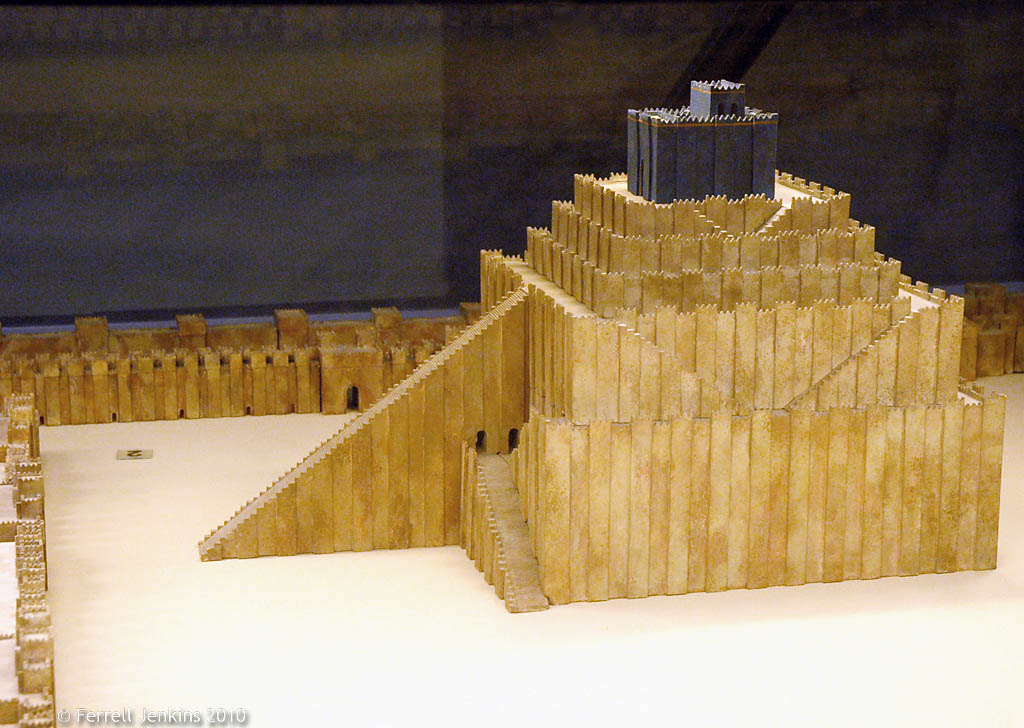 Ziggurat Model in Pergamum Museum, Berlin[/caption]Let’s consider Genesis 28:10-22. This passage is famously remembered as “Jacob’s Ladder.” Here God appears to Jacob in a dream. The LORD stands above a ladder (or “flight of steps”) and makes great promises for Jacob and his family’s future. There are similarities and differences between Jacob’s dream and another famous passage in Genesis: the Tower of Babel. The connection between the two stories is clearest in the stairways or flights of steps (Genesis 28:12) that reach to the heavens (Genesis 11:4). In both passages, a ziggurat is being described. A ziggurat was a large building that invited the gods to come down the steps from heaven and bring their blessing to the earth. The builders of Babel set the ladder up in the earth; in Jacob’s dream, God is the builder and he sets up the ladder. Due to a distorted grasp of God, the builders in Babel thought he could be coerced to give them the heavenly life; in Jacob’s dream, the LORD comes to Jacob to explain how the heavenly life will be brought to the earth. The point is this: the blessed life that humanity desires will not come through human technological advancement but through God’s covenant with Abraham.Eventually, many centuries after Jacob dreamed that dream, Jesus, a son of Abraham, spoke with a man named Nathanael. He explained to Nathanael that he is the ultimate fulfillment of Jacob’s ladder (J
 ohn 1:51). Jesus Christ is the way that heaven and earth are bridged so that God’s Kingdom can come to earth as it is in heaven. And rather than pleading our great worth to the Father because of our development of super-computers, Jesus died for our sins. Ultimate human flourishing required the sacrifice of the Son of God, not more hours at the office.Now, technology is not opposed to the Kingdom of God. Although some may say that we must choose between science and faith, we ought to see the two as linked: science and faith. Technological advancement is not enough to bring about true human fulfillment. God must be at the center of the equation and Jesus, the son of Jacob, is the only mediator between God and men (2 Timothy 2:5). He is Lord of all, and all, including technology, must be brought into submission to his good purposes for the world.QUESTIONS FOR CONVERSATION1. What technologies do you use most? How are they typically used? Do you find yourself using them that way? Is that use helping to shape you and others into the way of Christ?2. Have you ever heard anyone make the argument that humanity’s best future lies in technological advancement? Can you think of movies or TV Shows that have featured that hope?3. How is the covenant with Abraham (Genesis 12) the way that God will bring true human fulfillment to the earth?4. How has technology furthered the Kingdom of Jesus? How might it hinder it?
Ephesians 3:14-4:1
14 For this reason I bow my knees before the Father, 15 from whom every family in heaven and on earth is named, 16 that according to the riches of his glory he may grant you to be strengthened with power through his Spirit in your inner being, 17 so that Christ may dwell in your hearts through faith—that you, being rooted and grounded in love, 18 may have strength to comprehend with all the saints what is the breadth and length and height and depth, 19 and to know the love of Christ that surpasses knowledge, that you may be filled with all the fullness of God.20 Now to him who is able to do far more abundantly than all that we ask or think, according to the power at work within us, 21 to him be glory in the church and in Christ Jesus throughout all generations, forever and ever. Amen.4 I therefore, a prisoner for the Lord, urge you to walk in a manner worthy of the calling to which you have been called,
Judges 3:12-30
Judges 3:12-30 12 And the people of Israel again did what was evil in the sight of the Lord, and the Lord strengthened Eglon the king of Moab against Israel, because they had done what was evil in the sight of the Lord. 13 He gathered to himself the Ammonites and the Amalekites, and went and defeated Israel. And they took possession of the city of palms. 14 And the people of Israel served Eglon the king of Moab eighteen years.15 Then the people of Israel cried out to the Lord, and the Lord raised up for them a deliverer, Ehud, the son of Gera, the Benjaminite, a left-handed man. The people of Israel sent tribute by him to Eglon the king of Moab. 16 And Ehud made for himself a sword with two edges, a cubit in length, and he bound it on his right thigh under his clothes. 17 And he presented the tribute to Eglon king of Moab. Now Eglon was a very fat man. 18 And when Ehud had finished presenting the tribute, he sent away the people who carried the tribute. 19 But he himself turned back at the idols near Gilgal and said, “I have a secret message for you, O king.” And he commanded, “Silence.” And all his attendants went out from his presence. 20 And Ehud came to him as he was sitting alone in his cool roof chamber. And Ehud said, “I have a message from God for you.” And he arose from his seat. 21 And Ehud reached with his left hand, took the sword from his right thigh, and thrust it into his belly. 22 And the hilt also went in after the blade, and the fat closed over the blade, for he did not pull the sword out of his belly; and the dung came out. 23 Then Ehud went out into the porch and closed the doors of the roof chamber behind him and locked them.24 When he had gone, the servants came, and when they saw that the doors of the roof chamber were locked, they thought, “Surely he is relieving himself in the closet of the cool chamber.” 25 And they waited till they were embarrassed. But when he still did not open the doors of the roof chamber, they took the key and opened them, and there lay their lord dead on the floor.26 Ehud escaped while they delayed, and he passed beyond the idols and escaped to Seirah. 27 When he arrived, he sounded the trumpet in the hill country of Ephraim. Then the people of Israel went down with him from the hill country, and he was their leader.28 And he said to them, “Follow after me, for the Lord has given your enemies the Moabites into your hand.” So they went down after him and seized the fords of the Jordan against the Moabites and did not allow anyone to pass over. 29 And they killed at that time about 10,000 of the Moabites, all strong, able-bodied men; not a man escaped. 30 So Moab was subdued that day under the hand of Israel. And the land had rest for eighty years.
Genesis 27
When Isaac was old and his eyes were dim so that he could not see, he called Esau his older son and said to him, "My son"; and he answered, "Here I am." 2 He said, "Behold, I am old; I do not know the day of my death. 3 Now then, take your weapons, your quiver and your bow, and go out to the field and hunt game for me, 4 and prepare for me delicious food, such as I love, and bring it to me so that I may eat, that my soul may bless you before I die."5 Now Rebekah was listening when Isaac spoke to his son Esau. So when Esau went to the field to hunt for game and bring it, 6 Rebekah said to her son Jacob, "I heard your father speak to your brother Esau, 7 'Bring me game and prepare for me delicious food, that I may eat it and bless you before the LORD before I die.' 8 Now therefore, my son, obey my voice as I command you. 9 Go to the flock and bring me two good young goats, so that I may prepare from them delicious food for your father, such as he loves. 10 And you shall bring it to your father to eat, so that he may bless you before he dies." 11 But Jacob said to Rebekah his mother, "Behold, my brother Esau is a hairy man, and I am a smooth man. 12 Perhaps my father will feel me, and I shall seem to be mocking him and bring a curse upon myself and not a blessing." 13 His mother said to him, "Let your curse be on me, my son; only obey my voice, and go, bring them to me."14 So he went and took them and brought them to his mother, and his mother prepared delicious food, such as his father loved. 15 Then Rebekah took the best garments of Esau her older son, which were with her in the house, and put them on Jacob her younger son. 16 And the skins of the young goats she put on his hands and on the smooth part of his neck. 17 And she put the delicious food and the bread, which she had prepared, into the hand of her son Jacob.18 So he went in to his father and said, "My father." And he said, "Here I am. Who are you, my son?" 19 Jacob said to his father, "I am Esau your firstborn. I have done as you told me; now sit up and eat of my game, that your soul may bless me." 20 But Isaac said to his son, "How is it that you have found it so quickly, my son?" He answered, "Because the LORD your God granted me success." 21 Then Isaac said to Jacob, "Please come near, that I may feel you, my son, to know whether you are really my son Esau or not." 22 So Jacob went near to Isaac his father, who felt him and said, "The voice is Jacob's voice, but the hands are the hands of Esau." 23 And he did not recognize him, because his hands were hairy like his brother Esau's hands. So he blessed him. 24 He said, "Are you really my son Esau?" He answered, "I am." 25 Then he said, "Bring it near to me, that I may eat of my son's game and bless you." So he brought it near to him, and he ate; and he brought him wine, and he drank.26 Then his father Isaac said to him, "Come near and kiss me, my son." 27 So he came near and kissed him. And Isaac smelled the smell of his garments and blessed him and said, "See, the smell of my sonis as the smell of a field that the LORD has blessed!28 May God give you of the dew of heavenand of the fatness of the earthand plenty of grain and wine.29 Let peoples serve you,and nations bow down to you.Be lord over your brothers,and may your mother's sons bow down to you.Cursed be everyone who curses you,and blessed be everyone who blesses you!"
Genesis 25:19-34
This is the genealogy of Isaac, Abraham's son. Abraham begot Isaac. 20Isaac was forty years old when he took Rebekah as wife, the daughter of Bethuel the Syrian of Padan Aram, the sister of Laban the Syrian. 21Now Isaac pleaded with the LORD for his wife, because she was barren; and the LORD granted his plea, and Rebekah his wife conceived. 22But the children struggled together within her; and she said, "If all is well, why am I like this?" So she went to inquire of the LORD. 23And the LORD said to her: "Two nations are in your womb,Two peoples shall be separated from your body;One people shall be stronger than the other,And the older shall serve the younger." 24So when her days were fulfilled for her to give birth, indeed there were twins in her womb. 25And the first came out red. He was like a hairy garment all over; so they called his name Esau. 26Afterward his brother came out, and his hand took hold of Esau's heel; so his name was called Jacob. Isaac was sixty years old when she bore them.27So the boys grew. And Esau was a skillful hunter, a man of the field; but Jacob was a mild man, dwelling in tents. 28And Isaac loved Esau because he ate of his game, but Rebekah loved Jacob.29Now Jacob cooked a stew; and Esau came in from the field, and he was weary. 30And Esau said to Jacob, "Please feed me with that same red stew, for I am weary." Therefore his name was called Edom.31But Jacob said, "Sell me your birthright as of this day."32And Esau said, "Look, I am about to die; so what is this birthright to me?"33Then Jacob said, "Swear to me as of this day."So he swore to him, and sold his birthright to Jacob. 34And Jacob gave Esau bread and stew of lentils; then he ate and drank, arose, and went his way. Thus Esau despised his birthright.New King James Version
The Practices of Passionate Spirituality
Passionate Spirituality – who doesn’t want it? Consider how important it is to Starbucks and Teavana. They have recently begun a campaign where with every cup of coffee you get a “Steep Your Soul” quote. They write that the “Steep your Soul” quotes “invite you to take a few moments to pause and reflect each day. Your own personal steep time.” Then, on the other side of your Quad-Half-Calf-2%-Caramel-Macchiato you get a quote to help you steep you soul. One cup quotes Oprah Winfrey: Know what sparks the light in you. Then use that light to illuminate the world.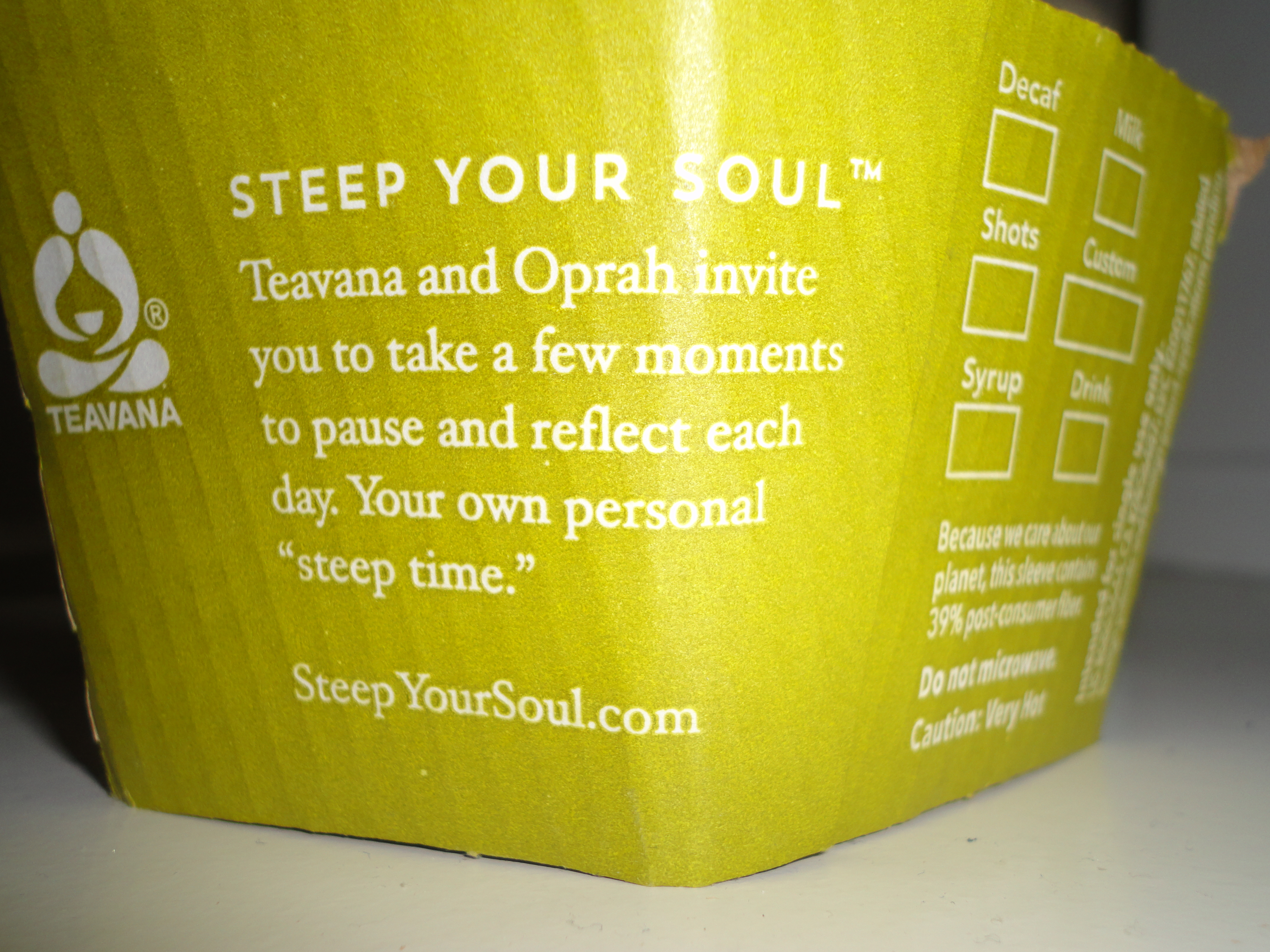 I mention all that to make the point that the general population who have common sense (that would exclude those who prefer Dunkin Donuts) are also interested in spirituality. Here’s the thing. Not that I don’t like Oprah but who made her the authority on spirituality? She could teach me endless things about how to run a company or host a talk show but when it comes to spirituality I am going to the Bible.
 So what exactly is spirituality according to the Bible? Well, as Jesus said, “God is Spirit”. Further, after Jesus rose physically from the dead he sent God the Holy Spirit (Acts 2). The Holy Spirit is essential to true human flourishing or true Spirituality (note the capital “S”). He comes as the gift to all those that trust that Jesus’ death saves. He comes as the guide for all those longing for a renewed human life of true and passionate Spirituality.What about passion? What does that have to do with Spirituality? Well, to put it simply – if you have Spirituality then you have passion (or desire or longing or loving or whatever you want to call it). The two go together like coffee and cream. Jesus said, “Where your treasure is there your heart will be also.” If my passion is not for the kingdom of God then my longing will be for some alternate kingdom, some other vision of human flourishing.Alright, granting you want to be passionately Spiritual, and not just in some bland pluralist “sparks the light” blah blah blah sort of way but the Jesus-Christ-True-to-Reality sort of way, then you want to know how to go about it. Here’s the kick – it doesn’t just happen. In the Old and New Testament God again and again commends practices and habits that help to develop passionate Spirituality. Gathering with others for regular worship, singing songs together about the Kingdom of God, praying alone and with others, listening to the voice of God in Scripture, being still before God in recognition of his majesty, and others are examples of practices that help to further passionate Spirituality. The Scriptures even commend wise creativity with respect to these practices. For example, Jesus went to synagogue week-in-and-week-out yet this was never commanded (Luke 4:16).Warning: these practices are not to be honed in order to force God to do stuff for you. These practices are not to be trotted out as reasons for people to notice you. These practices are not to be done the same way by everybody at all times and places.The idea is that just as a trellis gives guidance for the vine so too Spiritual practices give structure to the truly passionate life in Christ. Rooted in Jesus through faith we can grow more and more into those who truly long for the Kingdom of God on earth as it is in heaven.
Mark 12:28-34
28 One of the teachers of the law came and heard them debating. Noticing that Jesus had given them a good answer, he asked him, "Of all the commandments, which is the most important?" 29 "The most important one," answered Jesus, "is this: 'Hear, O Israel, the Lord our God, the Lord is one. 30 Love the Lord your God with all your heart and with all your soul and with all your mind and with all your strength.' 31 The second is this: 'Love your neighbor as yourself.' There is no commandment greater than these." 32 "Well said, teacher," the man replied. "You are right in saying that God is one and there is no other but him. 33 To love him with all your heart, with all your understanding and with all your strength, and to love your neighbor as yourself is more important than all burnt offerings and sacrifices." 34 When Jesus saw that he had answered wisely, he said to him, "You are not far from the kingdom of God." And from then on no one dared ask him any more questions.
Mothers, Who Needs 'Em - Genesis 24
 Mothers. They are the first people any of us ever come into contact with. To say that mothers are vital to our existence is as obvious as the noses on our faces. The care and nurture that has come from good mothering is incalculable in its value.But we don’t need a mother anymore. That is to say we don’t need a mother in the sense that Abraham and Isaac did. In Genesis 24 there is a crisis: without a wife for Isaac there is no mother to continue Abraham’s line. If there is no continuation of Abraham’s line, then there is no Jesus Christ (see the Gospel according to Matthew 1:1). If there is no Jesus Christ, then all that is wrong in the world will not be made right again. We needed a mother, and we needed one badly. Through an unequivocal governing of events, Rebekah was singled out by the LORD to be the next mother of Israel. For over a millennium, countless mothers in Israel continued to bear the seed of Abraham until the last mother conceived: Mary. Although both Rebekah and Mary were virgins, Mary contrasts with Rebekah in an important way. Mary remained a virgin and yet conceived – another unequivocal governing of events by the LORD to bring about his kind promises of renewal. The child in her womb would grow to the One: Jesus Christ the ultimate fulfillment of the covenant made with Abraham (see Galatians 3:10-14).[caption id="attachment_4065" align="alignleft" width="236"]
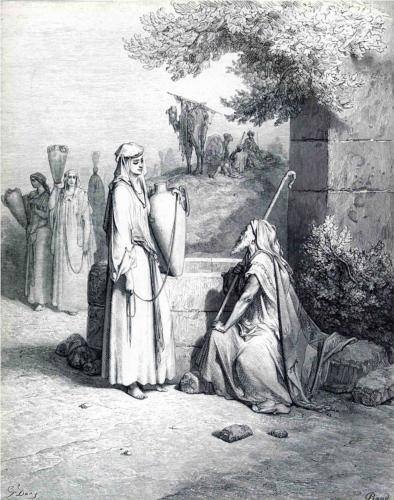 Eliezer and Rebekah by Gustave Dore[/caption]So, the fulfillment of God’s covenantal promises to Abraham required a mother. But they don’t anymore. We don’t need a mother because we do have a brother: Jesus Christ. Our brother Jesus Christ was sent by our Father to die and rise from the dead so we could be adopted into his family through the Comforter, the Spirit of Adoption (see Romans 8:15). So the first thing Genesis 24 teaches us is that we should grow in joy because we have a loving Brother, and a providing Father, and a Comforter through God’s provision of countless mothers.Yet the covenant promises of God continue to play out. We await the return of Jesus Christ by actively expanding the boundaries of the kingdom of God through all nations in every sphere of society. We are called to be witnesses to this great work of God in every relationship and role that we find ourselves in. So the covenant people of God need mothers now more than ever. The Church needs video game inventors, soccer coaches, grandfathers, woodworkers and engineers. Christ’s family needs sisters, politicians, jackhammer workers and poets. By the help of the Spirit of Christ, we need every person giving everything to this great and good work of God.Questions for Conversation
- Read Genesis 24
o Why would you assert that this story is not primarily about whether every woman should wear nose rings? Give evidence.o Why would you say that this scene is not primarily about how Christians are supposed to find wives? Give reasons.o Why would you claim that this passage is not primarily about how to obtain information about the will of God today? Substantiate the claim. (Hint: remember that revelation is historically progressive in the Bible).
- What relationships are you most passionate about in life? What roles do you find yourself that energize you?
- Tell your conversation partner(s) a story about that relates to that relationship or role. (for example: I am passionate about being a godly father and recently my son and I went to a great baseball game. Here’s what happened…).
- Now tell how you think God would have you like out that role in the future. (for example: my long distance friend and I swap dozens of books and discuss via Skype how they are truly helping us love God and emotionally connect with our wives. Meanwhile I also buy my wife a nose-ring in order to honor Rebekah's mothering of Israel.)
Genesis 23
Genesis 23 Sarah lived 127 years; these were the years of the life of Sarah. 2 And Sarah died at Kiriath-arba (that is, Hebron) in the land of Canaan, and Abraham went in to mourn for Sarah and to weep for her. 3 And Abraham rose up from before his dead and said to the Hittites, 4 "I am a sojourner and foreigner among you; give me property among you for a burying place, that I may bury my dead out of my sight." 5 The Hittites answered Abraham, 6 "Hear us, my lord; you are a prince of God among us. Bury your dead in the choicest of our tombs. None of us will withhold from you his tomb to hinder you from burying your dead." 7 Abraham rose and bowed to the Hittites, the people of the land. 8 And he said to them, "If you are willing that I should bury my dead out of my sight, hear me and entreat for me Ephron the son of Zohar, 9 that he may give me the cave of Machpelah, which he owns; it is at the end of his field. For the full price let him give it to me in your presence as property for a burying place." 10 Now Ephron was sitting among the Hittites, and Ephron the Hittite answered Abraham in the hearing of the Hittites, of all who went in at the gate of his city, 11 "No, my lord, hear me: I give you the field, and I give you the cave that is in it. In the sight of the sons of my people I give it to you. Bury your dead." 12 Then Abraham bowed down before the people of the land. 13 And he said to Ephron in the hearing of the people of the land, "But if you will, hear me: I give the price of the field. Accept it from me, that I may bury my dead there." 14 Ephron answered Abraham, 15 "My lord, listen to me: a piece of land worth four hundred shekels of silver, what is that between you and me? Bury your dead." 16 Abraham listened to Ephron, and Abraham weighed out for Ephron the silver that he had named in the hearing of the Hittites, four hundred shekels of silver, according to the weights current among the merchants. 17 So the field of Ephron in Machpelah, which was to the east of Mamre, the field with the cave that was in it and all the trees that were in the field, throughout its whole area, was made over 18 to Abraham as a possession in the presence of the Hittites, before all who went in at the gate of his city. 19 After this, Abraham buried Sarah his wife in the cave of the field of Machpelah east of Mamre (that is, Hebron) in the land of Canaan. 20 The field and the cave that is in it were made over to Abraham as property for a burying place by the Hittites.
This Is Only a Test - Genesis 22
Creatures are contingent. Creatures who have sinned against their holy Creator are most certainly contingent, only breathing by the mercy of their kind Creator who desires their repentance. In Genesis 22 Moses recounts the history of God’s testing of Abraham. The test consisted of God’s commanding Abraham to sacrifice his son Isaac. God’s command was therefore in direct conflict with his promise that through Isaac would come about a great nation that would bless all other nations. As Israel first listened to this account, they would have sensed the contingency of their own lives, as they imagined Isaac bound on the altar with a knife barreling down towards his throat. They would have been relieved when the angel of the LORD declared that Abraham need not touch Isaac and that through Isaac the covenant for creation’s renewal would continue. (The covenant with Abraham can be termed “the covenant for creation’s renewal,” as that is God’s purpose for entering into this covenant: to renew all of creation back to its original harmony). Yet, God’s command could still be kept, for the LORD provided a ram to be sacrificed in Isaac’s place. Not only so, but the ram was provided in the exact place (Moriah) that would later be the location of the temple where the LORD accepted the sacrifices of Israel for their sins. Even more significant is that just outside the walls of the same city is where the LORD provided a sacrifice on behalf of the life of his people: Jesus Christ, crucified outside the walls of Jerusalem.[caption id="attachment_4050" align="alignright" width="300"]
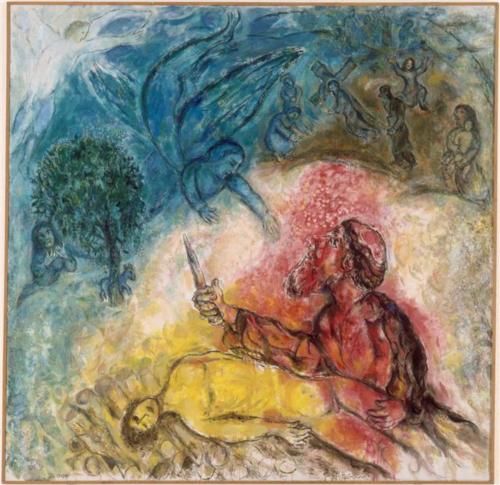 The Sacrifice of Isaac, by Marc Chagall, 1966[/caption]The covenant of creation’s renewal could only continue through Isaac, Israel and Jesus’ people today because of the LORD's provision. Jesus Christ, the Ram of God, sacrificed in the place of the people of God so that God’s good intentions for the nations can be accomplished by his grace and through his people. If the ram had not been provided, then the covenant promises could not have been accomplished and the world would have reverted back to Genesis 11. But I wonder if we really believe that. Do we really think that without the offspring of Abraham the world would revert back to the chaos of the Tower of Babel? Do we really feel the full impact of what was on the line as Isaac was on the altar? Do we sense the need for the Church, or do we think that the world will get along just fine by virtue of good governments, good schools and strong individual responsibility and hard work? Have we slipped into thinking that individual responsibility and ingenuity are the answer to the world’s problems? If so, we ought to be reminded that the LORD is the one who provides for the world’s true, deepest problems - and he does so through Jesus Christ: who gives life to his people for the sake of renewing creation by God’s power.Questions for Conversation
- Can you think of a movie, TV show or recent book in which the answer to the world’s problems came through individual responsibility and ingenuity?
- How would you counter that philosophy using the book of Genesis and God’s covenant with Abraham?
- This passage can be troubling. If you are troubled by it can you explain why? Does knowing that this is a test of Abraham help you? How?
- Where would you go in the Scripture to defend God’s honor regarding child sacrifice?
- How does this passage help you to better understand God the Father’s intention in Christ’s sacrifice?
Genesis 21:8-21
Genesis 21:8-21 8 The child grew and was weaned, and on the day Isaac was weaned Abraham held a great feast. 9 But Sarah saw that the son whom Hagar the Egyptian had borne to Abraham was mocking, 10 and she said to Abraham, “Get rid of that slave woman and her son, for that woman’s son will never share in the inheritance with my son Isaac.”11 The matter distressed Abraham greatly because it concerned his son. 12 But God said to him, “Do not be so distressed about the boy and your slave woman. Listen to whatever Sarah tells you, because it is through Isaac that your offspringwill be reckoned. 13 I will make the son of the slave into a nation also, because he is your offspring.”14 Early the next morning Abraham took some food and a skin of water and gave them to Hagar. He set them on her shoulders and then sent her off with the boy. She went on her way and wandered in the Desert of Beersheba.15 When the water in the skin was gone, she put the boy under one of the bushes. 16 Then she went off and sat down about a bowshot away, for she thought, “I cannot watch the boy die.” And as she sat there, shebegan to sob.17 God heard the boy crying, and the angel of God called to Hagar from heaven and said to her, “What is the matter, Hagar? Do not be afraid; God has heard the boy crying as he lies there. 18 Lift the boy up and take him by the hand, for I will make him into a great nation.”19 Then God opened her eyes and she saw a well of water. So she went and filled the skin with water and gave the boy a drink.20 God was with the boy as he grew up. He lived in the desert and became an archer. 21 While he was living in the Desert of Paran, his mother got a wife for him from Egypt.

Justice League of Heaven - Genesis 18:16-33
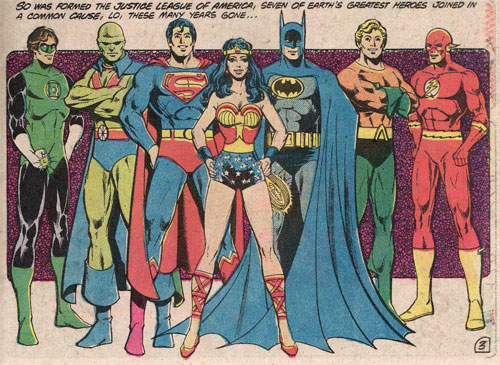 Did you ever read comic books or enjoy watching one of the recent Avengers movies? If so you are probably also familiar with The Justice League of America. The Justice League was made up of all the DC Comic Books greats: Wonder Woman, Batman, Green Lantern, Superman and others. Their whole mission was about bringing justice and righteousness into the world. With some modifications the same can be said of the Church of Jesus Christ, the seed of Abraham - we are the Justice League of Heaven.As those who know that they are secured a home in the new heavens and earth by grace through faith in Jesus we may wonder how living lives of justice and righteousness fits into the life of the Church. Maybe we are even tempted to think that justice and righteousness are for people caught up with being self-righteous. Certainly humans, in their rebellion against God, have shown the propensity for using their good works to turn their nose up at the world. But, when understood in the right way we see that justice and righteousness are simply the right response to God's mercy towards us. Living lives of justice and righteousness, God says, is what God called Abraham to do so that all the nations would be blessed. For you and I who have trusted in Jesus Christ, the Offspring of Abraham, we too have been ingrafted into the people of Abraham; through faith in Jesus Christ's death and resurrection on our behalf we have been given redemptive roles. As God says in Genesis 18:17-19, the nations will be blessed when Abraham and his household live up to their calling - to live lives of justice and righteousness.So, suit up Wonder Woman! Get your tights on Green Lantern! The Just and Righteous Lord of Heaven has forgiven you, adopted you and gifted you with his Holy Spirit so that you can help further the work of the greatest bunch of superheros ever - the Justice League of Heaven.Questions for Conversation- We learned about how God displays justice and righteousness through being non-prejudiced in his judgments of others, through hearing out the oppressed and correcting the oppressor, and by being more concerned to bless the world than to condemn. Which of these makes you admire God most? Why?- Who were your heros growing up? Why? Did they display aspects of justice and righteousness?- Where have you experienced injustice in life? Does that motivate you to want to address that injustice in life?- We learned that Abraham demonstrated the way of the Lord by interceding for Sodom and Gomorrah. Who do you have a hard time loving but need to begin praying for their good?

Communion Diet Plan - John 6
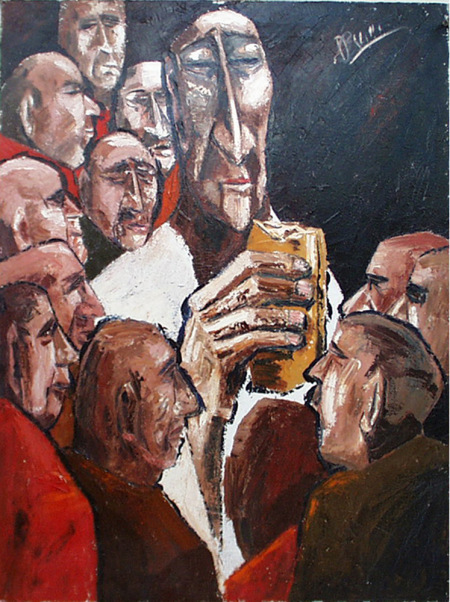 You’ve got to eat to live, and some diets promote life better than others. For example, the all-fried-chicken-and-cake diet isn’t going to leave you as fresh and healthy as the all-cabbage-and-low-fat diet (although you may be happier on the other). For as long as I can remember there has been a yearly frenzy about one new diet or another. Our hope at Crossroads is to be part of a movement to make a different diet all the frenzy: the Communion Diet.Jesus advocates this diet plan in John 6. Here is a short breakdown:
- The meal plan consists of Jesus’ flesh and blood.
- The food is absolutely free, provided at the expense of God the Father, Son and Holy Spirit.
- The food never goes bad – it is imperishable.
- The benefits are eternal life beginning now and a perfect body at the resurrection.
- It energizes you to live life for the right reasons.
- 100% satisfaction is guaranteed.
The reason it is called the “communion” diet plan is because of the relational nature of it. It is actually a feeding upon Jesus in the deepest of intimate relations. Or, to put it in other terms, by trusting in Jesus, we enter into a moment-by-moment daily transaction of receiving life from the Father through the Son and by the Holy Spirit. This is what it means to feed on Jesus.Of course, if you have been around church long enough, you are thinking of the Lord’s Supper or Communion. You should. Those who first read the sixth chapter of the Gospel of John would’ve been thinking of it also. During our faithful participation in the Lord’s Supper, we actually are fed the living and resurrected Christ by the mysterious power of the Holy Spirit. Although God’s people are always in union with Jesus Christ, there is a special way in which the Church communes with Jesus at the Table. Maybe it’s something like living in your family’s home all year but really deeply relating with everyone over Thanksgiving dinner.Not only do we deeply commune with the Triune God at the Lord’s Table, 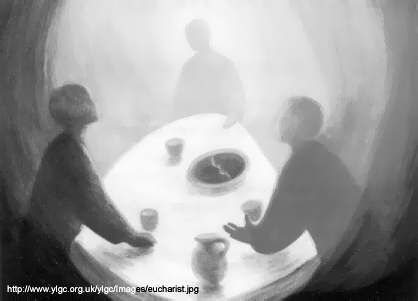 but we also keep the main thing the main thing. A church can easily become centered around lots of peripheral issues, but the Communion Diet keeps us focused on what’s important: the Trinity, the Incarnation, the atonement and forgiveness, the resurrection and eternal life, salvation by grace alone through faith alone in Christ alone to the glory of God alone.QUESTIONS FOR CONVERSATION
- Have you ever become bored with diets you’ve been on? Why?
- Can one become bored with God’s Diet Plan? How come?
- What kinds of emotions well up when you hear Jesus say that you must eat his flesh and blood (John 6:53)?
- Put in your own words what Jesus means by feeding upon his flesh and blood based on 6:56-57.
- Think of a neighbor, co-worker, or family member who is not on this Diet Plan. If you were to tell them about how to get on this Diet Plan, what would be the most important element to emphasize for them?