

Sermons
The Lion of Judah - Genesis 49:1-28
[caption id="attachment_4372" align="alignright" width="200"]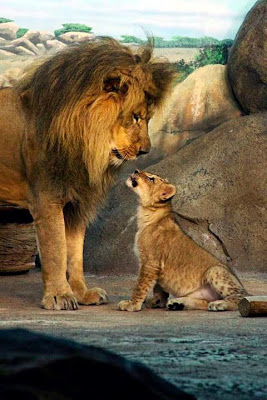 Lion and cub[/caption]Genesis 49:1-28 contain some of the last words of our patriarch Jacob. What would you like your last words to be? What would you hate for your last words to be?
 Oxen Yoked with Burden[/caption]
The Rock was Christ - Exodus 17:1-7
[caption id="attachment_4336" align="alignleft" width="300"] Pyramid and Sphinx[/caption]Our passage this week features the people of God after leaving Egypt in the Exodus. Talk about an aspect of Egyptian history that you find particularly interesting. For example the pyramids, the Sphinx, mummies, the Nile, Coptic Orthodoxy, etc.Rev. Muldoon said that the Israeilites were failing to let God be God. Considering the larger sweep of the story of the Exodus up to this point and then 17:1-3 how is it that they are failing to do this? Why is this a sin? What would it mean for them to allow God to be God? Why would this be better?This can be applied to how we treat one another as God’s image-bearers also. Why is it important that we allow other people to be who they are rather than to be someone/thing else? How could doing so honor God?
 Psalms were originally given to God’s people to be sung as a community. In this way the words would be owned and embodied by the people at appropriate times. Read Psalm 88. Why is this not teaching God's people to grumble? How is this different from what Israel did in Exodus 17?Is there a difference between grumbling and complaining or lamenting? What is it?Rev. Muldoon said that “all sin must be punished.” How did Exodus 17 prefigure how the sin of God’s people would be punished?[caption id="attachment_4335" align="alignright" width="300"]
 Big Electric Chair by Andy Warhol, 1967[/caption]Read Paul’s letter to the Colossians 2:13-14. How many sins are we responsible for now or in the future?How does Colossians 2:13-14 help you to understand that your relationship with God is based on what Jesus has done rather than what you do? How might this give us freedom in the way that we covenantally-relate with God day-to-day? Try to give a specific and concrete example.
Disturbing the Peace? - Genesis 41:50-45
1. We've heard about Joseph's and others dreams the past few weeks. Not to say your dream was intended to tell the future, but what is an interesting dream you've had in your life? Do you remember the characters, setting and plot? Describe for the group.2. Were you disturbed or comforted by the message that God will disturb false peace in order to achieve true peace?3. What is "false peace"?4. What, then, is "true peace"?5. How does this help to make sense out of Jesus' teaching that "blessed are the peacemakers for they shall be called sons of God"?6. How is it true that we are like our Father (sons of God) when we seek reconciliation? Restricting ourselves to Genesis, how has God shown he wants reconciliation in history?7. Have you ever known someone who would rather live with false peace than pursue true peace through reconciliation?8. Have you seen reconciliation happen in a church?9. Have you tried and succeeded or failed in true peacemaking? How?10. Why is peacemaking a particularly important aspect of adult Spirit-ual formation?11. Do you see where God might be graciously working events so that you might pursue true peace in conflicted relationships?
Genesis 41:1-57
41 When two full years had passed, Pharaoh had a dream: He was standing by the Nile, 2 when out of the river there came up seven cows, sleek and fat, and they grazed among the reeds. 3 After them, seven other cows, ugly and gaunt, came up out of the Nile and stood beside those on the riverbank. 4 And the cows that were ugly and gaunt ate up the seven sleek, fat cows. Then Pharaoh woke up.
5 He fell asleep again and had a second dream: Seven heads of grain, healthy and good, were growing on a single stalk. 6 After them, seven other heads of grain sprouted—thin and scorched by the east wind. 7 The thin heads of grain swallowed up the seven healthy, full heads. Then Pharaoh woke up; it had been a dream.8 In the morning his mind was troubled, so he sent for all the magicians and wise men of Egypt. Pharaoh told them his dreams, but no one could interpret them for him.9 Then the chief cupbearer said to Pharaoh, “Today I am reminded of my shortcomings. 10 Pharaoh was once angry with his servants, and he imprisoned me and the chief baker in the house of the captain of the guard. 11 Each of us had a dream the same night, and each dream had a meaning of its own. 12 Now a young Hebrew was there with us, a servant of the captain of the guard. We told him our dreams, and he interpreted them for us, giving each man the interpretation of his dream. 13 And things turned out exactly as he interpreted them to us: I was restored to my position, and the other man was impaled.”14 So Pharaoh sent for Joseph, and he was quickly brought from the dungeon. When he had shaved and changed his clothes, he came before Pharaoh.15 Pharaoh said to Joseph, “I had a dream, and no one can interpret it. But I have heard it said of you that when you hear a dream you can interpret it.”16 “I cannot do it,” Joseph replied to Pharaoh, “but God will give Pharaoh the answer he desires.”17 Then Pharaoh said to Joseph, “In my dream I was standing on the bank of the Nile, 18 when out of the river there came up seven cows, fat and sleek, and they grazed among the reeds. 19 After them, seven other cows came up—scrawny and very ugly and lean. I had never seen such ugly cows in all the land of Egypt. 20 The lean, ugly cows ate up the seven fat cows that came up first. 21 But even after they ate them, no one could tell that they had done so; they looked just as ugly as before. Then I woke up.22 “In my dream I saw seven heads of grain, full and good, growing on a single stalk. 23 After them, seven other heads sprouted—withered and thin and scorched by the east wind. 24 The thin heads of grain swallowed up the seven good heads. I told this to the magicians, but none of them could explain it to me.”25 Then Joseph said to Pharaoh, “The dreams of Pharaoh are one and the same. God has revealed to Pharaoh what he is about to do. 26 The seven good cows are seven years, and the seven good heads of grain are seven years; it is one and the same dream. 27 The seven lean, ugly cows that came up afterward are seven years, and so are the seven worthless heads of grain scorched by the east wind: They are seven years of famine.28 “It is just as I said to Pharaoh: God has shown Pharaoh what he is about to do. 29 Seven years of great abundance are coming throughout the land of Egypt, 30 but seven years of famine will follow them. Then all the abundance in Egypt will be forgotten, and the famine will ravage the land. 31 The abundance in the land will not be remembered, because the famine that follows it will be so severe. 32 The reason the dream was given to Pharaoh in two forms is that the matter has been firmly decided by God, and God will do it soon.33 “And now let Pharaoh look for a discerning and wise man and put him in charge of the land of Egypt. 34 Let Pharaoh appoint commissioners over the land to take a fifth of the harvest of Egypt during the seven years of abundance. 35 They should collect all the food of these good years that are coming and store up the grain under the authority of Pharaoh, to be kept in the cities for food. 36 This food should be held in reserve for the country, to be used during the seven years of famine that will come upon Egypt, so that the country may not be ruined by the famine.”37 The plan seemed good to Pharaoh and to all his officials. 38 So Pharaoh asked them, “Can we find anyone like this man, one in whom is the spirit of God?”39 Then Pharaoh said to Joseph, “Since God has made all this known to you, there is no one so discerning and wise as you. 40 You shall be in charge of my palace, and all my people are to submit to your orders. Only with respect to the throne will I be greater than you.”
Joseph in Charge of Egypt
41 So Pharaoh said to Joseph, “I hereby put you in charge of the whole land of Egypt.” 42 Then Pharaoh took his signet ring from his finger and put it on Joseph’s finger. He dressed him in robes of fine linen and put a gold chain around his neck. 43 He had him ride in a chariot as his second-in-command, and people shouted before him, “Make way!” Thus he put him in charge of the whole land of Egypt.44 Then Pharaoh said to Joseph, “I am Pharaoh, but without your word no one will lift hand or foot in all Egypt.” 45 Pharaoh gave Joseph the name Zaphenath-Paneah and gave him Asenath daughter of Potiphera, priest of On, to be his wife. And Joseph went throughout the land of Egypt.46 Joseph was thirty years old when he entered the service of Pharaoh king of Egypt. And Joseph went out from Pharaoh’s presence and traveled throughout Egypt. 47 During the seven years of abundance the land produced plentifully. 48 Joseph collected all the food produced in those seven years of abundance in Egypt and stored it in the cities. In each city he put the food grown in the fields surrounding it. 49 Joseph stored up huge quantities of grain, like the sand of the sea; it was so much that he stopped keeping records because it was beyond measure.50 Before the years of famine came, two sons were born to Joseph by Asenath daughter of Potiphera, priest of On. 51 Joseph named his firstborn Manasseh and said, “It is because God has made me forget all my trouble and all my father’s household.” 52 The second son he named Ephraim and said, “It is because God has made me fruitful in the land of my suffering.”53 The seven years of abundance in Egypt came to an end, 54 and the seven years of famine began, just as Joseph had said. There was famine in all the other lands, but in the whole land of Egypt there was food. 55 When all Egypt began to feel the famine, the people cried to Pharaoh for food. Then Pharaoh told all the Egyptians, “Go to Joseph and do what he tells you.”56 When the famine had spread over the whole country, Joseph opened all the storehouses and sold grain to the Egyptians, for the famine was severe throughout Egypt. 57 And all the world came to Egypt to buy grain from Joseph, because the famine was severe everywhere.
God and the Earth's Future - 2 Peter 3:3-13
[caption id="attachment_4291" align="alignright" width="253"] Rainbow, by Billy Apple, 1965[/caption]Last week’s sermon focused on God’s promise to restore and transform the earth by smelting away the impurity of sin at the return of Jesus from heaven (a Restorationist view). This is in contrast to the popular view that God’s relationship with the earth will end when he totally destroys it at Christ's return creating a different one afterwards (an Annihilationist view). First we looked at the big picture, noting how a Restorationist view does better justice to the unfolding drama of creation, human rebellion, and redemption. We were created into a web of good relationships that were broken by human rebellion. God is in the business of destroying sin and Satan in the efforts to redeem his good work of creation, which includes human beings. On an annihilationist view the relationship between God and the earth is lost, Satan has corrupted and marred the earth and gets what he always wanted – ultimate destruction of God’s good work of creation.We then looked at 2 Peter 3:3-13. Noting that Peter is making a comparison between the Flood in Noah’s day and the coming judgment of the ungodly we concluded that the future judgment is not a destruction of God’s good work of creation but “destruction of the ungodly” (v. 7). The extreme heat and burning will be of all evil and effects of death thereby restoring and even transforming creation into the place where righteousness will be established forever (v. 13).
 What do you find most beautiful about God’s creation during this Autumn season?If the sermon was to have been abbreviated to one or two quick points which ones would you say should be included no matter what?In Genesis 9:13 what is included in the covenant that God made with Noah? How does this illustrate the relationship between God and the earth?Acts 3:18-21 – How much will be restored by the Spirit when Jesus returns?Romans 8:19-25 – What is presented as groaning with human beings it longs for God’s redemption from the effects of sin?Colossians 1:15-20 – How much was created through Christ? How much is restored through Christ’s death and resurrection?In 1 John 3:8b the Apostle writes that “the reason the Son of God appeared was to destroy the works of the devil.” Whose works did the Son of God not come to destroy?God has obviously placed a value on his good work of creation. Should creations value be measured by God or by humanity?[caption id="attachment_4293" align="alignright" width="300"]
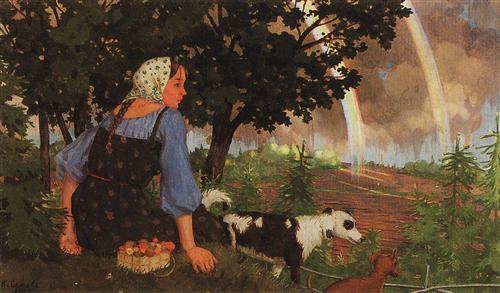 The Girl with the Mushroom Under the Rainbow, by Konstantin Somav, 1922[/caption]How is creation’s value to God different from or the same as its value to humans?
Take One For the Team - Genesis 39
(LEADER) Garments have played a prominent role in the last three chapters of Genesis (Joseph’s coat, Tamar’s veil, and Joseph’s garment taken by Potiphar’s wife). Ask a few people to tell stories from their lives when clothing played a key role. (Ex. disagreements with parents about what to wear; the first time they tried to dress themselves; strange things they wore; clothes they had to wear for work that they wouldn’t be caught dead in; etc.)(LEADER) What’s one thing from last weekend’s message that you hope to talk about as a group?Invite someone to read Genesis 12:1-3(LEADER) How is the LORD’s choosing, or electing, evident in this passage?(LEADER) Keeping in mind Genesis 3-11, how is God’s choosing Abraham gracious? Was humanity interested in bearing God’s image throughout the earth? (Remember that Abraham was part of cultural project of Genesis 11:1-9).Invite someone to read the following quote: “Israel, the people of Abraham, was conscious of a unique role and status among the nations given to them by God in his act of choosing and calling Abraham. Certain things were true of them that were not true of other peoples. God did certain things in relation to them that he did not do to others. Much was demanded of them that was not, in quite the same way, demanded of others. Great was their privilege. Greater still was their responsibility.” from The Mission of God by Christopher J. H. WrightInvite someone to read Genesis 39:1-12(LEADER) How did God work through Joseph, one of Abraham’s offspring, to fulfill his promise to bring blessing to the nations? How did Joseph bless Potiphar by refusing his wife?(LEADER) How has God been using you to be a blessing to others, even if they are not part of the Church? Be concrete and specific. (examples include in-laws; friend at the water cooler; Panera; Christmas-time; tax season; etc)Invite someone to read 1 Peter 2:19-25(LEADER) How do the Apostle Peter’s words clarify that God’s gracious election of us means sometimes “taking one for the team”?(LEADER) How is it most true in the life of our Christ our Savior?(LEADER) Where have you experienced difficulty in relationship with others because of your commitment to God’s agenda?(LEADER) How could God still use that to further help the Church or even those who caused you difficulty?
Geared for the Weak - Genesis 38
[caption id="attachment_4263" align="alignright" width="191"]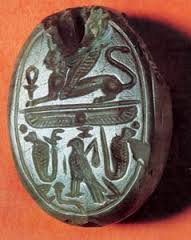 Jezebel's Royal Seal in the Israel Museum, Jerusalem[/caption]Dr. John Walton, of Wheaton University, writes, “Judah’s guarantee of payment for his act of prostitution is his seal, cord, and staff. The seal is most likely a stamp seal engraved with a design that would uniquely identify Judah. It would be used by him for any transaction or correspondence much as we use a signature today… Seals were often worn around the neck on a cord…his staff is a walking stick but may have been a symbol of authority in his clan. If so, Tamar holds in her possession symbols of his individual and corporate identity – in modern terms, items akin to someone’s driver’s license” (The NIV Application Commentary: Genesis, 669).(LEADER) Enter into the story of Genesis 38 and get to know each other better by asking willing participants to pass their license around to the other participants. Ask them to tell a story about when they had their picture, what the DMV was like, or something like that.(If anyone is interested in having a good reference book on the cultural background of the Old Testament they can purchase the IVP Bible Background Commentary edited by Walton, Matthews and Chavalas.)Everybody quietly read Genesis 38:1-11.(LEADER) Ask if anyone can explain how the powerful (Judah and his sons) in those verses are keeping the less powerful (Tamar) in a position of weakness. How are the powerful displayed as not giving the weak the benefit of the doubt?Everybody quietly read Genesis 38:12-30.(LEADER) Ask if anyone can recall how the passage displays God gearing his kingdom for the sake of the weak (Tamar).(LEADER) Ask which systems today (work, family, society, church, economy, sports, etc.) are geared toward those in power? Which systems are geared toward those who are not in the positions of power?(LEADER) Matthew 1:2-6 mentions that Tamar, as well as Gentile-women like Rahab and Ruth, are part of Jesus’ family line. What does this tell you about how God uses weakness and powerlessness in his kingdom? How does this give you hope?(LEADER) As the Apostle Paul neared the end of his life, he wrote to his protégé
  Timothy, “All Scripture is breathed out by God” (2 Timothy 3:16). Genesis 38 is a passage which refers to a variety of sexual activity. Explain why this is a good thing for the people of God to know. How is this a resource to families? Ask if any members have wisdom about how to discuss sexual activity to children and teens. Ask if any would like to share a story of how they learned about these things.
Genesis 37:2-36
2 This is the account of Jacob’s family line. Joseph, a young man of seventeen, was tending the flocks with his brothers, the sons of Bilhah and the sons of Zilpah, his father’s wives, and he brought their father a bad report about them.3 Now Israel loved Joseph more than any of his other sons, because he had been born to him in his old age; and he made an ornate robe for him. 4 When his brothers saw that their father loved him more than any of them, they hated him and could not speak a kind word to him. 5 Joseph had a dream, and when he told it to his brothers, they hated him all the more. 6 He said to them, “Listen to this dream I had: 7 We were binding sheaves of grain out in the field when suddenly my sheaf rose and stood upright, while your sheaves gathered around mine and bowed down to it.” 8 His brothers said to him, “Do you intend to reign over us? Will you actually rule us?” And they hated him all the more because of his dream and what he had said.9 Then he had another dream, and he told it to his brothers. “Listen,” he said, “I had another dream, and this time the sun and moon and eleven stars were bowing down to me.” 10 When he told his father as well as his brothers, his father rebuked him and said, “What is this dream you had? Will your mother and I and your brothers actually come and bow down to the ground before you?” 11 His brothers were jealous of him, but his father kept the matter in mind.12 Now his brothers had gone to graze their father’s flocks near Shechem, 13 and Israel said to Joseph, “As you know, your brothers are grazing the flocks near Shechem. Come, I am going to send you to them.” “Very well,” he replied. 14 So he said to him, “Go and see if all is well with your brothers and with the flocks, and bring word back to me.” Then he sent him off from the Valley of Hebron.When Joseph arrived at Shechem, 15 a man found him wandering around in the fields and asked him, “What are you looking for?” 16 He replied, “I’m looking for my brothers. Can you tell me where they are grazing their flocks?” 17 “They have moved on from here,” the man answered. “I heard them say, ‘Let’s go to Dothan.’” So Joseph went after his brothers and found them near Dothan.18 But they saw him in the distance, and before he reached them, they plotted to kill him. 19 “Here comes that dreamer!” they said to each other. 20 “Come now, let’s kill him and throw him into one of these cisterns and say that a ferocious animal devoured him. Then we’ll see what comes of his dreams.” 21 When Reuben heard this, he tried to rescue him from their hands. “Let’s not take his life,” he said. 22 “Don’t shed any blood. Throw him into this cistern here in the wilderness, but don’t lay a hand on him.” Reuben said this to rescue him from them and take him back to his father. 23 So when Joseph came to his brothers, they stripped him of his robe—the ornate robe he was wearing— 24 and they took him and threw him into the cistern. The cistern was empty; there was no water in it.25 As they sat down to eat their meal, they looked up and saw a caravan of Ishmaelites coming from Gilead. Their camels were loaded with spices, balm and myrrh, and they were on their way to take them down to Egypt. 26 Judah said to his brothers, “What will we gain if we kill our brother and cover up his blood? 27 Come, let’s sell him to the Ishmaelites and not lay our hands on him; after all, he is our brother, our own flesh and blood.” His brothers agreed. 28 So when the Midianite merchants came by, his brothers pulled Joseph up out of the cistern and sold him for twenty shekels of silver to the Ishmaelites, who took him to Egypt.29 When Reuben returned to the cistern and saw that Joseph was not there, he tore his clothes. 30 He went back to his brothers and said, “The boy isn’t there! Where can I turn now?” 31 Then they got Joseph’s robe, slaughtered a goat and dipped the robe in the blood. 32 They took the ornate robe back to their father and said, “We found this. Examine it to see whether it is your son’s robe.” 33 He recognized it and said, “It is my son’s robe! Some ferocious animal has devoured him. Joseph has surely been torn to pieces.” 34 Then Jacob tore his clothes, put on sackcloth and mourned for his son many days. 35 All his sons and daughters came to comfort him, but he refused to be comforted. “No,” he said, “I will continue to mourn until I join my son in the grave.” So his father wept for him. 36 Meanwhile, the Midianites sold Joseph in Egypt to Potiphar, one of Pharaoh’s officials, the captain of the guard.
Dynamically Living with God - Genesis 35:1-15
 Jacob’s name change to Israel is re-affirmed in Genesis 35. “What is the background of your name? Why were you given your name? Were you, for instance, named after a relative, family friend, biblical character, athlete, movie star?” (taken from Dan Allender’s To Be Told)
- The Christian life is a dynamic one where we, as God’s people, are meant to interact with God in intimate covenant communion for the sake of the building of the Kingdom of his Son Jesus Christ. We saw this in the relationship between Jacob and God Almighty (El Shaddai) in Genesis 35. First God instructed Jacob how to relate to him, Jacob/Israel obeyed and then God met him again in a revealing of his promises to Israel for personal communion and kingdom building.
 How do we see the same dynamic relationship described by Jesus in John 14:21?

- The promises made to Jacob/Israel in Genesis 35 contain references to many other places in the Bible. These promises have been referred to as the 4 “P”s. Does anyone remember what they are?
- Have different members in the group turn to Genesis 1:26-28; 9:1; 12:1-3, 17:4-8 and 35:11-12 and show where they find the four “P”s of God’s covenant promises affirmed.
- What is one thing from last week’s sermon that you hoped we would talk about and why?
 Pastor Tim pointed out that the Christian life is meant to be lived as a dynamic relationship where we are not “walking on eggshells” with God. What did he mean by “walking on eggshells”? Have you ever felt like you were “walking on eggshells” with God or somebody else? Explain.
The Grace of the Law - Genesis 34
[caption id="attachment_4215" align="alignleft" width="196"]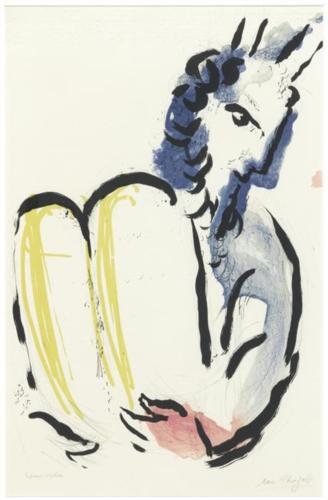 Moses, by Marc Chagall 1956[/caption]Following are questions for conversation based on the Genesis 34 sermon. Please feel free to leave questions or comment.
- Who is the author of Genesis? (Moses)
- Who is the original audience for whom the book of Genesis was originally written? (Israel after the Exodus and on the way to the promised land)
Read Genesis 34:
- Who is Dinah’s mother? Is she the more or less favored wife of Jacob?
- As appropriate to your group, discuss the following: What did Shechem do to Dinah?
- Has God revealed his laws to Israel at this point in history? When does God give the Ten Commandments and subsequent laws to Israel?
- How would God’s law have helped in a situation like this? (see Exodus 22:16-17 and Deuteronomy 22:28-29).
- Why might Jacob have under-reacted in hearing about the mistreatment of Dinah? (compare Jacob’s reaction in Genesis 34:5 to his reaction to Joseph’s supposed death in 37:31-35)
- When have you experienced or witnessed an under-reaction to evil? Share with the group.
- When the sons of Jacob return they react very strongly (v. 7) but then fail to exact a punishment that fit the crime (v. 25-29). How would laws from God have been a helpful provision in this case? Do any laws from the Old Testament come to mind as particularly relevant to this case? (see Exodus 21:23-24).
- When have you experienced or witnessed an over-reaction to evil? Share with the group.
- At the end of the story (v. 30-31) there is a disagreement between Jacob and his sons about what should have been done in response to Dinah’s severe mistreatment. Explain how this ending is “ambiguous.”
- How do God’s laws given to Israel clear up that ambiguity?
- The main point of this sermon was that the law is grace. How is law (or instruction) gracious?[caption id="attachment_4216" align="alignright" width="228"]
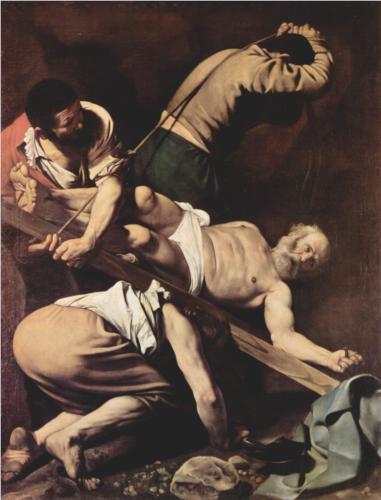
 Crucifixion of Saint Peter, by Caravaggio 1601[/caption]
 - Jesus, in John 13:34, commands his disciples. What has he commanded us to do?
- How is Jesus' instruction to love like him (laying down your life for others as he has laid down his life for us) a gracious thing?
- No one perfectly loves like Jesus, and that is why we need to continually be reminded that we are rooted in his sacrificial, complete and perfect love for us (Ephesians 3:14-21). When have you seen a local church love like Jesus, laying down its life for the sake of others? What opportunities does Crossroads have to love others like Jesus?
God's Tricky but He's Good - Genesis 32:22-32
[caption id="attachment_4167" align="alignright" width="300"] Jesters by Viktor Vasnetsov, 1885[/caption]Questions for Conversation
- What has God already promised Jacob according to chapter 28:13-15?
- Who else did God make these promises to in prior chapters of Genesis?
- How do these promises line up with the way God set up human life at creation (see Genesis 1-2).
- Read chapter 32:1-21.
- Who is Jacob afraid will attack and kill him? Why would Jacob be afraid of this? (Hint: see Genesis 27)
- Read 32:22-24
- Who do you think Jacob assumed the man was who attacked him in the night (see v. 24)?
- Read 32:25-30
- Who does Jacob realize it is in v. 30?
- Some people wonder how God, who cannot be seen and is a Spirit, can physically wrestle Jacob. Hosea 12:2-4 explains that an angel wrestled with Jacob. This is common for an angelic emissary of God to be God’s representative
- This was tricky of God to lead Jacob (and the hearers of Genesis) to think that it was a man who wrestled with him. But through this tricky attack God accomplished a few things:
- God can and does act shrewdly (withholding information) – he can be tricky.
- God is committed to his ancestral covenant promises to Jacob and is willing to act tricky to make that known. Do you remember how the putting Jacob’s hip out of joint indicated God’s commitment to keep his promises? (hint: see Genesis 24:1-3).
- Jacob’s tricky ways can be employed for the sake of God’s mission too. Do you remember how God helped Jacob to act shrewdly with Esau? (hint: see Genesis 32:1 and the meaning of “Mahanaim” in the ESV margin note and compare with what Jacob does in 32:7
- How was Jesus’ crucifixion the greatest trick that God ever played?
- How did that shrewd move by God fulfill his ancestral covenant promises to Abraham?
- How is God tricky in 2 Thessalonians 2:9-11?
- How is God’s trickiness employed for the sake of the covenant promises he has made to Christ’s people? How is his action performed for the sake of good?
- C.S. Lewis wrote of the Christ character in the Narnia series that “God is not safe but he’s good”. What do you think he meant by that? Does that help you understand how God can be tricky but also good?
- Why do we need the Bible to constantly expand and re-align our understanding of who God is toward us and others?
- Can you tell the group a story from your life when having your horizons expanded regarding Christ or the gospel really made a difference?
- God is obviously very serious about keeping his promise to Jacob, even giving him the enduring reminder in his hip joint.
- Do you believe that he is as committed to bring about salvation in the life of the church today? Where are you encouraged by what you see happening in the global, national or local church?
Genesis 29:1-35
Then Jacob went on his journey and came to the land of the people of the east. 2 As he looked, he saw a well in the field, and behold, three flocks of sheep lying beside it, for out of that well the flocks were watered. The stone on the well's mouth was large, 3 and when all the flocks were gathered there, the shepherds would roll the stone from the mouth of the well and water the sheep, and put the stone back in its place over the mouth of the well.4 Jacob said to them, "My brothers, where do you come from?" They said, "We are from Haran." 5 He said to them, "Do you know Laban the son of Nahor?" They said, "We know him." 6 He said to them, "Is it well with him?" They said, "It is well; and see, Rachel his daughter is coming with the sheep!" 7 He said, "Behold, it is still high day; it is not time for the livestock to be gathered together. Water the sheep and go, pasture them." 8 But they said, "We cannot until all the flocks are gathered together and the stone is rolled from the mouth of the well; then we water the sheep."9 While he was still speaking with them, Rachel came with her father's sheep, for she was a shepherdess. 10 Now as soon as Jacob saw Rachel the daughter of Laban his mother's brother, and the sheep of Laban his mother's brother, Jacob came near and rolled the stone from the well's mouth and watered the flock of Laban his mother's brother. 11 Then Jacob kissed Rachel and wept aloud. 12 And Jacob told Rachel that he was her father's kinsman, and that he was Rebekah's son, and she ran and told her father.13 As soon as Laban heard the news about Jacob, his sister's son, he ran to meet him and embraced him and kissed him and brought him to his house. Jacob told Laban all these things, 14 and Laban said to him, "Surely you are my bone and my flesh!" And he stayed with him a month.15 Then Laban said to Jacob, "Because you are my kinsman, should you therefore serve me for nothing? Tell me, what shall your wages be?" 16 Now Laban had two daughters. The name of the older was Leah, and the name of the younger was Rachel. 17 Leah's eyes were weak, but Rachel was beautiful in form and appearance. 18 Jacob loved Rachel. And he said, "I will serve you seven years for your younger daughter Rachel." 19 Laban said, "It is better that I give her to you than that I should give her to any other man; stay with me." 20 So Jacob served seven years for Rachel, and they seemed to him but a few days because of the love he had for her.21 Then Jacob said to Laban, "Give me my wife that I may go in to her, for my time is completed." 22 So Laban gathered together all the people of the place and made a feast. 23 But in the evening he took his daughter Leah and brought her to Jacob, and he went in to her. 24 (Laban gave his female servant Zilpah to his daughter Leah to be her servant.) 25 And in the morning, behold, it was Leah! And Jacob said to Laban, "What is this you have done to me? Did I not serve with you for Rachel? Why then have you deceived me?" 26 Laban said, "It is not so done in our country, to give the younger before the firstborn. 27 Complete the week of this one, and we will give you the other also in return for serving me another seven years." 28 Jacob did so, and completed her week. Then Laban gave him his daughter Rachel to be his wife. 29 (Laban gave his female servant Bilhah to his daughter Rachel to be her servant.) 30 So Jacob went in to Rachel also, and he loved Rachel more than Leah, and served Laban for another seven years.31 When the LORD saw that Leah was hated, he opened her womb, but Rachel was barren. 32 And Leah conceived and bore a son, and she called his name Reuben, for she said, "Because the LORD has looked upon my affliction; for now my husband will love me." 33 She conceived again and bore a son, and said, "Because the LORD has heard that I am hated, he has given me this son also." And she called his name Simeon. 34Again she conceived and bore a son, and said, "Now this time my husband will be attached to me, because I have borne him three sons." Therefore his name was called Levi. 35 And she conceived again and bore a son, and said, "This time I will praise the LORD." Therefore she called his name Judah. Then she ceased bearing.
Tech's Not Enough - Genesis 28
[caption id="attachment_4143" align="alignright" width="300"] Nanotube Space Elevator[/caption]Technology has exploded in recent history, and there’s no doubt that we are better off for it. Modern plumbing, travel by air, and medical advances are some of the first things that come to mind. I am happy that men and women have dreamed great dreams and sought to make them reality. And many now dream of where technology will take us next. Take the carbon nanotube, for instance. Some dream of a day when we will be able to build an elevator to space using this new molecular technology (www.youtube.com/watch?v=Kl083LAYnoU), and I hope that we can find a way to do it.Of course, the hope for technology to bridge heaven and earth can be taken metaphorically to stand for the hope that technology can lead us into an ideal future, an “age of abundance” www.youtube.com/watch?v=ceEog1XS5OI). This vision for the future is quite popular today and sounds like very good news. But here’s the question: Will technology usher in a peaceful, secure and happy future? Is technology the good news; is technological advancement the gospel?[caption id="attachment_3806" align="alignright" width="300"]
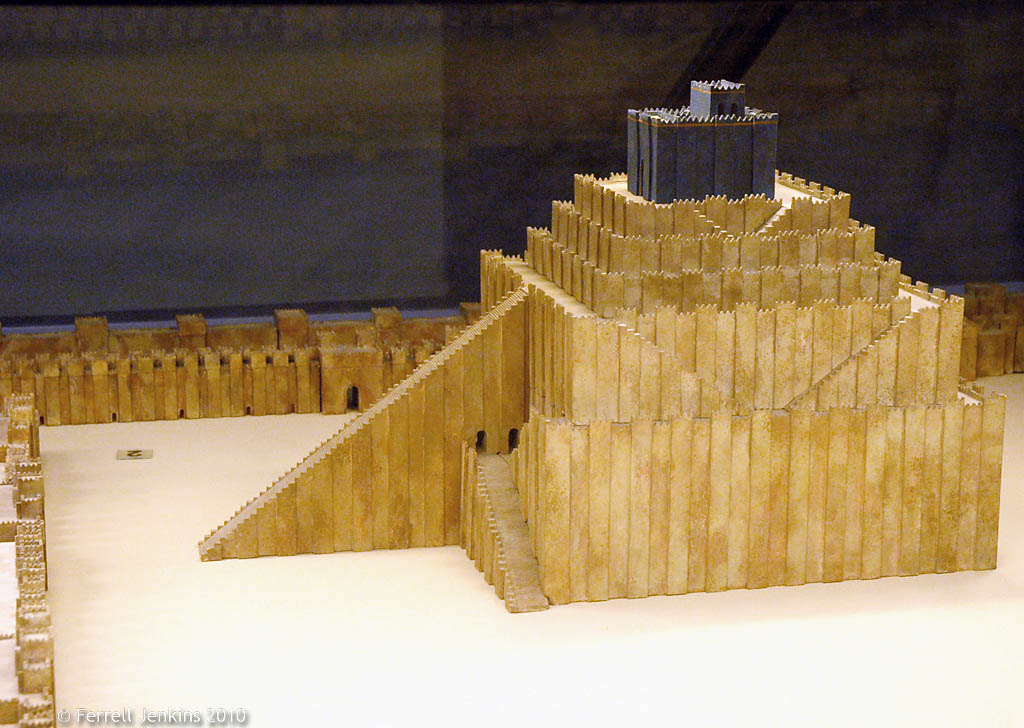 Ziggurat Model in Pergamum Museum, Berlin[/caption]Let’s consider Genesis 28:10-22. This passage is famously remembered as “Jacob’s Ladder.” Here God appears to Jacob in a dream. The LORD stands above a ladder (or “flight of steps”) and makes great promises for Jacob and his family’s future. There are similarities and differences between Jacob’s dream and another famous passage in Genesis: the Tower of Babel. The connection between the two stories is clearest in the stairways or flights of steps (Genesis 28:12) that reach to the heavens (Genesis 11:4). In both passages, a ziggurat is being described. A ziggurat was a large building that invited the gods to come down the steps from heaven and bring their blessing to the earth. The builders of Babel set the ladder up in the earth; in Jacob’s dream, God is the builder and he sets up the ladder. Due to a distorted grasp of God, the builders in Babel thought he could be coerced to give them the heavenly life; in Jacob’s dream, the LORD comes to Jacob to explain how the heavenly life will be brought to the earth. The point is this: the blessed life that humanity desires will not come through human technological advancement but through God’s covenant with Abraham.Eventually, many centuries after Jacob dreamed that dream, Jesus, a son of Abraham, spoke with a man named Nathanael. He explained to Nathanael that he is the ultimate fulfillment of Jacob’s ladder (J
 ohn 1:51). Jesus Christ is the way that heaven and earth are bridged so that God’s Kingdom can come to earth as it is in heaven. And rather than pleading our great worth to the Father because of our development of super-computers, Jesus died for our sins. Ultimate human flourishing required the sacrifice of the Son of God, not more hours at the office.Now, technology is not opposed to the Kingdom of God. Although some may say that we must choose between science and faith, we ought to see the two as linked: science and faith. Technological advancement is not enough to bring about true human fulfillment. God must be at the center of the equation and Jesus, the son of Jacob, is the only mediator between God and men (2 Timothy 2:5). He is Lord of all, and all, including technology, must be brought into submission to his good purposes for the world.QUESTIONS FOR CONVERSATION1. What technologies do you use most? How are they typically used? Do you find yourself using them that way? Is that use helping to shape you and others into the way of Christ?2. Have you ever heard anyone make the argument that humanity’s best future lies in technological advancement? Can you think of movies or TV Shows that have featured that hope?3. How is the covenant with Abraham (Genesis 12) the way that God will bring true human fulfillment to the earth?4. How has technology furthered the Kingdom of Jesus? How might it hinder it?
Ephesians 3:14-4:1
14 For this reason I bow my knees before the Father, 15 from whom every family in heaven and on earth is named, 16 that according to the riches of his glory he may grant you to be strengthened with power through his Spirit in your inner being, 17 so that Christ may dwell in your hearts through faith—that you, being rooted and grounded in love, 18 may have strength to comprehend with all the saints what is the breadth and length and height and depth, 19 and to know the love of Christ that surpasses knowledge, that you may be filled with all the fullness of God.20 Now to him who is able to do far more abundantly than all that we ask or think, according to the power at work within us, 21 to him be glory in the church and in Christ Jesus throughout all generations, forever and ever. Amen.4 I therefore, a prisoner for the Lord, urge you to walk in a manner worthy of the calling to which you have been called,
Judges 3:12-30
Judges 3:12-30 12 And the people of Israel again did what was evil in the sight of the Lord, and the Lord strengthened Eglon the king of Moab against Israel, because they had done what was evil in the sight of the Lord. 13 He gathered to himself the Ammonites and the Amalekites, and went and defeated Israel. And they took possession of the city of palms. 14 And the people of Israel served Eglon the king of Moab eighteen years.15 Then the people of Israel cried out to the Lord, and the Lord raised up for them a deliverer, Ehud, the son of Gera, the Benjaminite, a left-handed man. The people of Israel sent tribute by him to Eglon the king of Moab. 16 And Ehud made for himself a sword with two edges, a cubit in length, and he bound it on his right thigh under his clothes. 17 And he presented the tribute to Eglon king of Moab. Now Eglon was a very fat man. 18 And when Ehud had finished presenting the tribute, he sent away the people who carried the tribute. 19 But he himself turned back at the idols near Gilgal and said, “I have a secret message for you, O king.” And he commanded, “Silence.” And all his attendants went out from his presence. 20 And Ehud came to him as he was sitting alone in his cool roof chamber. And Ehud said, “I have a message from God for you.” And he arose from his seat. 21 And Ehud reached with his left hand, took the sword from his right thigh, and thrust it into his belly. 22 And the hilt also went in after the blade, and the fat closed over the blade, for he did not pull the sword out of his belly; and the dung came out. 23 Then Ehud went out into the porch and closed the doors of the roof chamber behind him and locked them.24 When he had gone, the servants came, and when they saw that the doors of the roof chamber were locked, they thought, “Surely he is relieving himself in the closet of the cool chamber.” 25 And they waited till they were embarrassed. But when he still did not open the doors of the roof chamber, they took the key and opened them, and there lay their lord dead on the floor.26 Ehud escaped while they delayed, and he passed beyond the idols and escaped to Seirah. 27 When he arrived, he sounded the trumpet in the hill country of Ephraim. Then the people of Israel went down with him from the hill country, and he was their leader.28 And he said to them, “Follow after me, for the Lord has given your enemies the Moabites into your hand.” So they went down after him and seized the fords of the Jordan against the Moabites and did not allow anyone to pass over. 29 And they killed at that time about 10,000 of the Moabites, all strong, able-bodied men; not a man escaped. 30 So Moab was subdued that day under the hand of Israel. And the land had rest for eighty years.
Genesis 27
When Isaac was old and his eyes were dim so that he could not see, he called Esau his older son and said to him, "My son"; and he answered, "Here I am." 2 He said, "Behold, I am old; I do not know the day of my death. 3 Now then, take your weapons, your quiver and your bow, and go out to the field and hunt game for me, 4 and prepare for me delicious food, such as I love, and bring it to me so that I may eat, that my soul may bless you before I die."5 Now Rebekah was listening when Isaac spoke to his son Esau. So when Esau went to the field to hunt for game and bring it, 6 Rebekah said to her son Jacob, "I heard your father speak to your brother Esau, 7 'Bring me game and prepare for me delicious food, that I may eat it and bless you before the LORD before I die.' 8 Now therefore, my son, obey my voice as I command you. 9 Go to the flock and bring me two good young goats, so that I may prepare from them delicious food for your father, such as he loves. 10 And you shall bring it to your father to eat, so that he may bless you before he dies." 11 But Jacob said to Rebekah his mother, "Behold, my brother Esau is a hairy man, and I am a smooth man. 12 Perhaps my father will feel me, and I shall seem to be mocking him and bring a curse upon myself and not a blessing." 13 His mother said to him, "Let your curse be on me, my son; only obey my voice, and go, bring them to me."14 So he went and took them and brought them to his mother, and his mother prepared delicious food, such as his father loved. 15 Then Rebekah took the best garments of Esau her older son, which were with her in the house, and put them on Jacob her younger son. 16 And the skins of the young goats she put on his hands and on the smooth part of his neck. 17 And she put the delicious food and the bread, which she had prepared, into the hand of her son Jacob.18 So he went in to his father and said, "My father." And he said, "Here I am. Who are you, my son?" 19 Jacob said to his father, "I am Esau your firstborn. I have done as you told me; now sit up and eat of my game, that your soul may bless me." 20 But Isaac said to his son, "How is it that you have found it so quickly, my son?" He answered, "Because the LORD your God granted me success." 21 Then Isaac said to Jacob, "Please come near, that I may feel you, my son, to know whether you are really my son Esau or not." 22 So Jacob went near to Isaac his father, who felt him and said, "The voice is Jacob's voice, but the hands are the hands of Esau." 23 And he did not recognize him, because his hands were hairy like his brother Esau's hands. So he blessed him. 24 He said, "Are you really my son Esau?" He answered, "I am." 25 Then he said, "Bring it near to me, that I may eat of my son's game and bless you." So he brought it near to him, and he ate; and he brought him wine, and he drank.26 Then his father Isaac said to him, "Come near and kiss me, my son." 27 So he came near and kissed him. And Isaac smelled the smell of his garments and blessed him and said, "See, the smell of my sonis as the smell of a field that the LORD has blessed!28 May God give you of the dew of heavenand of the fatness of the earthand plenty of grain and wine.29 Let peoples serve you,and nations bow down to you.Be lord over your brothers,and may your mother's sons bow down to you.Cursed be everyone who curses you,and blessed be everyone who blesses you!"
Genesis 25:19-34
This is the genealogy of Isaac, Abraham's son. Abraham begot Isaac. 20Isaac was forty years old when he took Rebekah as wife, the daughter of Bethuel the Syrian of Padan Aram, the sister of Laban the Syrian. 21Now Isaac pleaded with the LORD for his wife, because she was barren; and the LORD granted his plea, and Rebekah his wife conceived. 22But the children struggled together within her; and she said, "If all is well, why am I like this?" So she went to inquire of the LORD. 23And the LORD said to her: "Two nations are in your womb,Two peoples shall be separated from your body;One people shall be stronger than the other,And the older shall serve the younger." 24So when her days were fulfilled for her to give birth, indeed there were twins in her womb. 25And the first came out red. He was like a hairy garment all over; so they called his name Esau. 26Afterward his brother came out, and his hand took hold of Esau's heel; so his name was called Jacob. Isaac was sixty years old when she bore them.27So the boys grew. And Esau was a skillful hunter, a man of the field; but Jacob was a mild man, dwelling in tents. 28And Isaac loved Esau because he ate of his game, but Rebekah loved Jacob.29Now Jacob cooked a stew; and Esau came in from the field, and he was weary. 30And Esau said to Jacob, "Please feed me with that same red stew, for I am weary." Therefore his name was called Edom.31But Jacob said, "Sell me your birthright as of this day."32And Esau said, "Look, I am about to die; so what is this birthright to me?"33Then Jacob said, "Swear to me as of this day."So he swore to him, and sold his birthright to Jacob. 34And Jacob gave Esau bread and stew of lentils; then he ate and drank, arose, and went his way. Thus Esau despised his birthright.New King James Version
The Practices of Passionate Spirituality
Passionate Spirituality – who doesn’t want it? Consider how important it is to Starbucks and Teavana. They have recently begun a campaign where with every cup of coffee you get a “Steep Your Soul” quote. They write that the “Steep your Soul” quotes “invite you to take a few moments to pause and reflect each day. Your own personal steep time.” Then, on the other side of your Quad-Half-Calf-2%-Caramel-Macchiato you get a quote to help you steep you soul. One cup quotes Oprah Winfrey: Know what sparks the light in you. Then use that light to illuminate the world. I mention all that to make the point that the general population who have common sense (that would exclude those who prefer Dunkin Donuts) are also interested in spirituality. Here’s the thing. Not that I don’t like Oprah but who made her the authority on spirituality? She could teach me endless things about how to run a company or host a talk show but when it comes to spirituality I am going to the Bible.
 So what exactly is spirituality according to the Bible? Well, as Jesus said, “God is Spirit”. Further, after Jesus rose physically from the dead he sent God the Holy Spirit (Acts 2). The Holy Spirit is essential to true human flourishing or true Spirituality (note the capital “S”). He comes as the gift to all those that trust that Jesus’ death saves. He comes as the guide for all those longing for a renewed human life of true and passionate Spirituality.What about passion? What does that have to do with Spirituality? Well, to put it simply – if you have Spirituality then you have passion (or desire or longing or loving or whatever you want to call it). The two go together like coffee and cream. Jesus said, “Where your treasure is there your heart will be also.” If my passion is not for the kingdom of God then my longing will be for some alternate kingdom, some other vision of human flourishing.Alright, granting you want to be passionately Spiritual, and not just in some bland pluralist “sparks the light” blah blah blah sort of way but the Jesus-Christ-True-to-Reality sort of way, then you want to know how to go about it. Here’s the kick – it doesn’t just happen. In the Old and New Testament God again and again commends practices and habits that help to develop passionate Spirituality. Gathering with others for regular worship, singing songs together about the Kingdom of God, praying alone and with others, listening to the voice of God in Scripture, being still before God in recognition of his majesty, and others are examples of practices that help to further passionate Spirituality. The Scriptures even commend wise creativity with respect to these practices. For example, Jesus went to synagogue week-in-and-week-out yet this was never commanded (Luke 4:16).Warning: these practices are not to be honed in order to force God to do stuff for you. These practices are not to be trotted out as reasons for people to notice you. These practices are not to be done the same way by everybody at all times and places.The idea is that just as a trellis gives guidance for the vine so too Spiritual practices give structure to the truly passionate life in Christ. Rooted in Jesus through faith we can grow more and more into those who truly long for the Kingdom of God on earth as it is in heaven.
Mark 12:28-34
28 One of the teachers of the law came and heard them debating. Noticing that Jesus had given them a good answer, he asked him, "Of all the commandments, which is the most important?" 29 "The most important one," answered Jesus, "is this: 'Hear, O Israel, the Lord our God, the Lord is one. 30 Love the Lord your God with all your heart and with all your soul and with all your mind and with all your strength.' 31 The second is this: 'Love your neighbor as yourself.' There is no commandment greater than these." 32 "Well said, teacher," the man replied. "You are right in saying that God is one and there is no other but him. 33 To love him with all your heart, with all your understanding and with all your strength, and to love your neighbor as yourself is more important than all burnt offerings and sacrifices." 34 When Jesus saw that he had answered wisely, he said to him, "You are not far from the kingdom of God." And from then on no one dared ask him any more questions.
Mothers, Who Needs 'Em - Genesis 24
 Mothers. They are the first people any of us ever come into contact with. To say that mothers are vital to our existence is as obvious as the noses on our faces. The care and nurture that has come from good mothering is incalculable in its value.But we don’t need a mother anymore. That is to say we don’t need a mother in the sense that Abraham and Isaac did. In Genesis 24 there is a crisis: without a wife for Isaac there is no mother to continue Abraham’s line. If there is no continuation of Abraham’s line, then there is no Jesus Christ (see the Gospel according to Matthew 1:1). If there is no Jesus Christ, then all that is wrong in the world will not be made right again. We needed a mother, and we needed one badly. Through an unequivocal governing of events, Rebekah was singled out by the LORD to be the next mother of Israel. For over a millennium, countless mothers in Israel continued to bear the seed of Abraham until the last mother conceived: Mary. Although both Rebekah and Mary were virgins, Mary contrasts with Rebekah in an important way. Mary remained a virgin and yet conceived – another unequivocal governing of events by the LORD to bring about his kind promises of renewal. The child in her womb would grow to the One: Jesus Christ the ultimate fulfillment of the covenant made with Abraham (see Galatians 3:10-14).[caption id="attachment_4065" align="alignleft" width="236"]
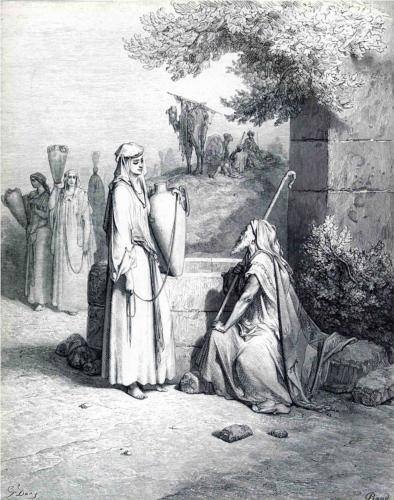 Eliezer and Rebekah by Gustave Dore[/caption]So, the fulfillment of God’s covenantal promises to Abraham required a mother. But they don’t anymore. We don’t need a mother because we do have a brother: Jesus Christ. Our brother Jesus Christ was sent by our Father to die and rise from the dead so we could be adopted into his family through the Comforter, the Spirit of Adoption (see Romans 8:15). So the first thing Genesis 24 teaches us is that we should grow in joy because we have a loving Brother, and a providing Father, and a Comforter through God’s provision of countless mothers.Yet the covenant promises of God continue to play out. We await the return of Jesus Christ by actively expanding the boundaries of the kingdom of God through all nations in every sphere of society. We are called to be witnesses to this great work of God in every relationship and role that we find ourselves in. So the covenant people of God need mothers now more than ever. The Church needs video game inventors, soccer coaches, grandfathers, woodworkers and engineers. Christ’s family needs sisters, politicians, jackhammer workers and poets. By the help of the Spirit of Christ, we need every person giving everything to this great and good work of God.Questions for Conversation
- Read Genesis 24
o Why would you assert that this story is not primarily about whether every woman should wear nose rings? Give evidence.o Why would you say that this scene is not primarily about how Christians are supposed to find wives? Give reasons.o Why would you claim that this passage is not primarily about how to obtain information about the will of God today? Substantiate the claim. (Hint: remember that revelation is historically progressive in the Bible).
- What relationships are you most passionate about in life? What roles do you find yourself that energize you?
- Tell your conversation partner(s) a story about that relates to that relationship or role. (for example: I am passionate about being a godly father and recently my son and I went to a great baseball game. Here’s what happened…).
- Now tell how you think God would have you like out that role in the future. (for example: my long distance friend and I swap dozens of books and discuss via Skype how they are truly helping us love God and emotionally connect with our wives. Meanwhile I also buy my wife a nose-ring in order to honor Rebekah's mothering of Israel.)