

Sermons
Eyewitness Testimony Translated - Mark 3:7-21
Mark 3:13-21 & the Twelve• The Gospel of Mark is an ancient biography. In an ancient biography there was one hero who was to be admired and imitated. How has Jesus thus far shown himself to be the hero? How has he been understood to be something other than the hero by the scribes and Pharisees?[caption id="attachment_5190" align="alignright" width="300"] Jesus and His Twelve Disciples by Sadao Wantanabe[/caption]
• According to Mark 3:14 and Acts 1:21-22 what is unique to the calling of the twelve apostles which sets them apart from other early followers of Christ? What else is unique to the Twelve in Mark 6:7 and 12? What are some of the transferable principles that apply to all disciples that underlie these unique aspects?
“Jesus called the Twelve to be with him so that he could give them specialized training for the role of assisting him in his earthly ministry as well as training that would equip them for their future role as apostles after his ascension. They were separated from their occupations, their families, and their regular activities so that for a period of time, somewhere around three years, they could be trained by Jesus.” from Following the Master by Wilkins
• Would you say that the Twelve were in a “Christian Bubble”? Why and if so how? How does Acts 6:2-4 help us see Jesus’ long-term goal for them?
• What did Tim mean when he said that the Gospel according to Mark is “Eyewitness Testimony Translated” How does that relate to the Bible being both reliable and relevant? Where and when in your life do you have opportunity to speak for the reliability and/or the relevance of Scripture?
• The Twelve’s testimony guides us into the real Jesus so that by his impact upon us we can be a fully functioning hand wherever we are. (A guide into union with Christ for the sake of the world). Why then would understanding the gospel as information transfer be an insufficient appreciation of the Gospel? Since the Gospel is not just information that fell out of the sky does that help you to sense a smile at the other end of the communication?
• Jesus chose Twelve to be with him more than the other disciples and three of the Twelve to be with him even more. Why is this a loving action on Jesus’ part?
Withered to Restored - Mark 3:1-6
Read Mark 3:1-6.
How might we, like the scribes, turn the instructions/commandments of God into a rival god? How is that really putting trust in your self rather than in the Lord?
Have you grasped that Jesus on the cross was taking upon himself that which you are most ashamed of about your body, your history and/or your heart? If you were to make a peice of art to depict what that looks like what colors, materials, etc. would you use?
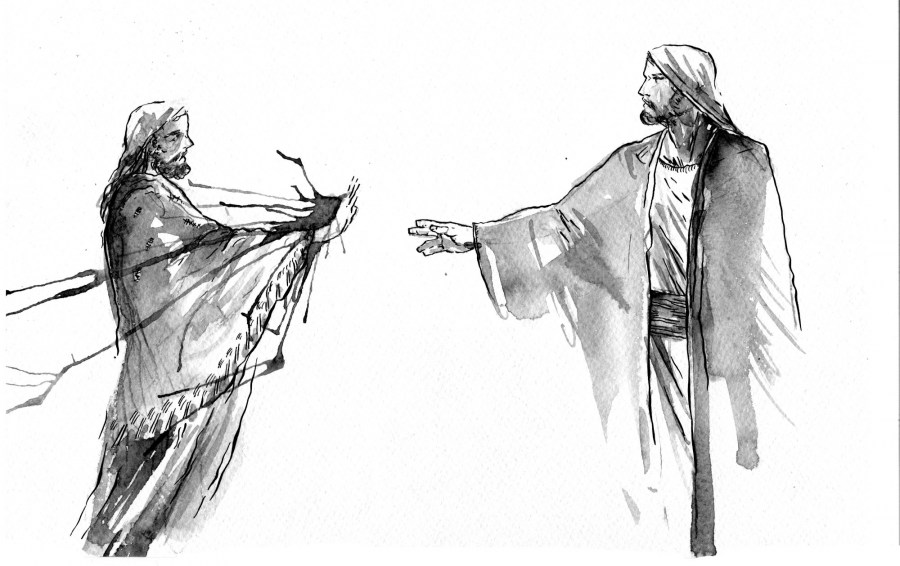 Do you have a sense for how your day to day life is a way of making God known in the world (being a "fully functioning hand")? Does that help you understand what it means to be an image-bearer? Explain.
Read Ezekiel 37:1-14. Is the theme of dry/withered (same word) being used in a similar way as Mark 3:1-6? Is the answer to that problem being addressed in the same way? For further background study see Isaiah 56.
Sustenance Despite Sin - Mark 2:23-28
[caption id="attachment_5129" align="alignleft" width="300"] "David and Ahimelech" by James Tissot[/caption]Read Mark 2:23-28
What do you most remember from the sermon?
How does Jesus use the story of David and the bread of the Presence (1 Samuel 21:1-6) to argue for the kingdom of God being established despite human disregard for God’s holiness?
Why is that such an important thing to keep in mind?
How can things go wrong if we think that the kingdom of God is sustained by our Christian practices rather than Christ’s person?
How can things go right for a local church when they realize that sustenance for the kingdom is provided despite sin?
Tim said that for the Pharisees the Sabbath had become Lord, rather than Jesus. Have practices and habits of the Christian life become Lord of any churches you have gone to or individuals that you’ve known?
What is beautiful about a person who relates to Jesus Christ as Lord rather than to prayer, Bible Study, attendance to Sunday worship, etc. as Lord?
Mark 2:18-22
Mark 2:18-2218 Now John's disciples and the Pharisees were fasting. Some people came and asked Jesus, "How is it that John's disciples and the disciples of the Pharisees are fasting, but yours are not?" 19 Jesus answered, "How can the guests of the bridegroom fast while he is with them? They cannot, so long as they have him with them. 20 But the time will come when the bridegroom will be taken from them, and on that day they will fast. 21 No one sews a patch of unshrunk cloth on an old garment. If he does, the new piece will pull away from the old, making the tear worse. 22 And no one pours new wine into old wineskins. If he does, the new wine will burst the skins, and both the wine and the wineskins will be ruined. No, he pours new wine into new wineskins."
Mark 2:13-17 - Bottom-Feeders Following & Feasting with Friends
[caption id="attachment_5120" align="alignleft" width="300"] Print can be found at https://www.etsy.com/listing/61993888/jesus-eats-with-friends[/caption]Read Mark 2:13-17
This story reflects one of many disagreements between Jesus and the religious establishment. Try to put yourself on both sides of the debate.
From the Pharisees point of view, why would it be bad for a rabbi (like Jesus) to eat with people of bad reputation?
From Jesus’ point of view, why was it necessary that he eat with people of bad reputation?
We must trust Jesus that we all are tax-collectors, sinners and bottom-feeders at heart. Why is it so necessary that we have this perception of ourselves for discipleship? If we have not committed enormous sins does that mean we must do so in order to follow Jesus?
Read Luke 15:1-7What was the emotional reaction of the Pharisees at Jesus’ fraternizing with tax-collectors?
What does Jesus’ parable reveal ought to be the Pharisee’s (and our) emotional reaction to Jesus fraternizing with tax-collectors and sinners?
What does this teach us about how to have joy as disciples?Do you gain a sense of joy from seeing Christ’s body, the Church, fraternize with sinners today? Should you? Why or why not?
Mark 2:1-12 - Jesus God-Identifies as Lord
 Read Mark 2:1-12
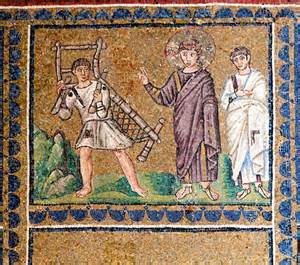
What motivated Jesus to respond to the paralytic’s plight was his friend’s faith (2:5). Why do you suppose their faith made such a difference?
In order to get a sense for what it means to put your faith or trust in somebody share a time when someone has put their faith in you. What was it like? How did it make you feel? How about a time when you have put your faith in someone else? Describe what that was like. What adjectives come to mind (ex. exhilarating, scary, etc.)?
Read James 2:14-26
How do the paralytic and his friends display the kind of faith that James is speaking about here?
“Saving faith,” writes Douglas Moo, “reveals itself in works.” That is, if we truly trust Jesus for the forgiveness of all our sins (past, present and future) on the basis of his death then our lives will reveal that faith by how we live.
How do we see this in our relationships with other people or things? When we trust them how does that naturally impact how we live? Give an example.
Read Mark 2:13-17
What about Jesus from these two stories intrigues you about him? Is there anything in these two stories that leads you to look up to him?Why might Mark choose to tell us this story about Jesus right after the story of the healing of the paralytic? Do you see a connection between these two stories? What is the flow or thought or the connection?
Mark 1:40-45 - Christ Heals a Leper
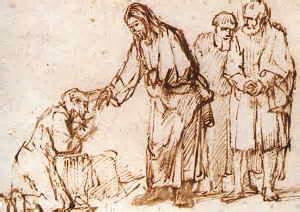 How are all humans, Christians and non-Christians, like the leper in the story?
How are Christians in particular like the leper in the story?
Tell a story about a time when you felt like the leper in your approach to Jesus.
Why is approaching Jesus in this way important for all disciples in all times and places?
In the beginning of worship we read a Call to Worship based on Genesis 1. How was God’s “speaking and it was so” like what we Jesus doing in this passage?
The leper approaches Jesus, is forgiven by Jesus and then is given directives by Jesus. As Colin pointed out the leper did not listen to Jesus. Are there words of Jesus that you find you have trouble carrying out? How would life be better if, hearing them, you obeyed?
Mark 1:35-39
35 Very early in the morning, while it was still dark, Jesus got up, left the house and went off to a solitary place, where he prayed. 36 Simon and his companions went to look for him, 37 and when they found him, they exclaimed: “Everyone is looking for you!” 38 Jesus replied, “Let us go somewhere else—to the nearby villages—so I can preach there also. That is why I have come.” 39 So he traveled throughout Galilee, preaching in their synagogues and driving out demons.
Accrediting Authority, Widening Horizons - Mark 1:29-34
Did last week’s sermon prompt any questions or trains of thought?The main point of the sermon was that Jesus certifies his authoritative right to disciple the world and thereby broadens our horizons for what it means to come under his authority as disciples.Read Mark 1:21-34
How did Jesus certify or accredit his authoritative claims in Mark 1:21-34?
Watch A.J. Miller claiming to be Jesus during his interview with “Mary Magdalene”.
https://www.youtube.com/watch?v=PztrAqv3LY4How does he certify the authority he claims? On what basis does he claim we should believe he is Jesus?
With every word or miracle of Jesus Peter’s horizons are broadened regarding what following Jesus means.
How has Jesus broadened your horizons regarding discipleship? In the area of scholarship, religious or otherwise? In the area of the invisible creation? In the arena of the visible creation? In the area of seasons or time?